
Last updated October 30, 2026
 Wrought iron
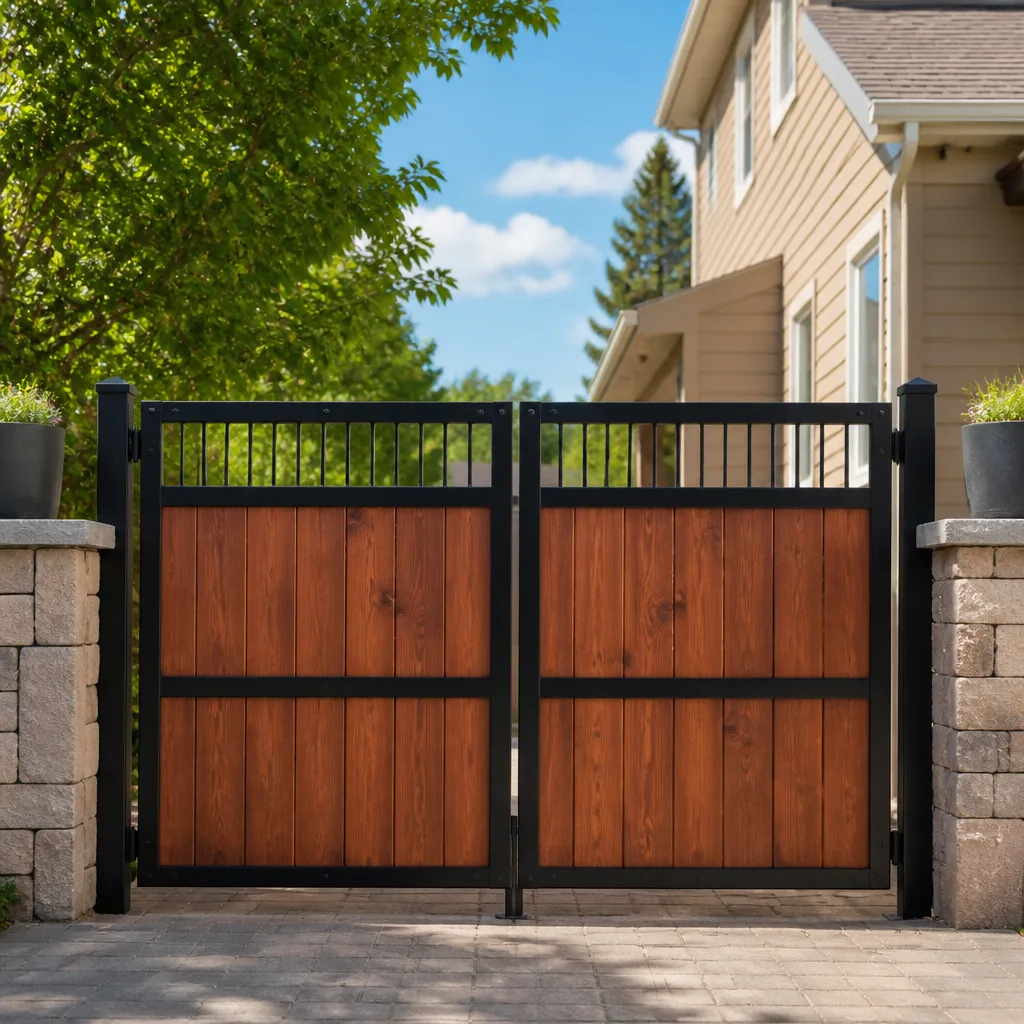 Wood & steel frame
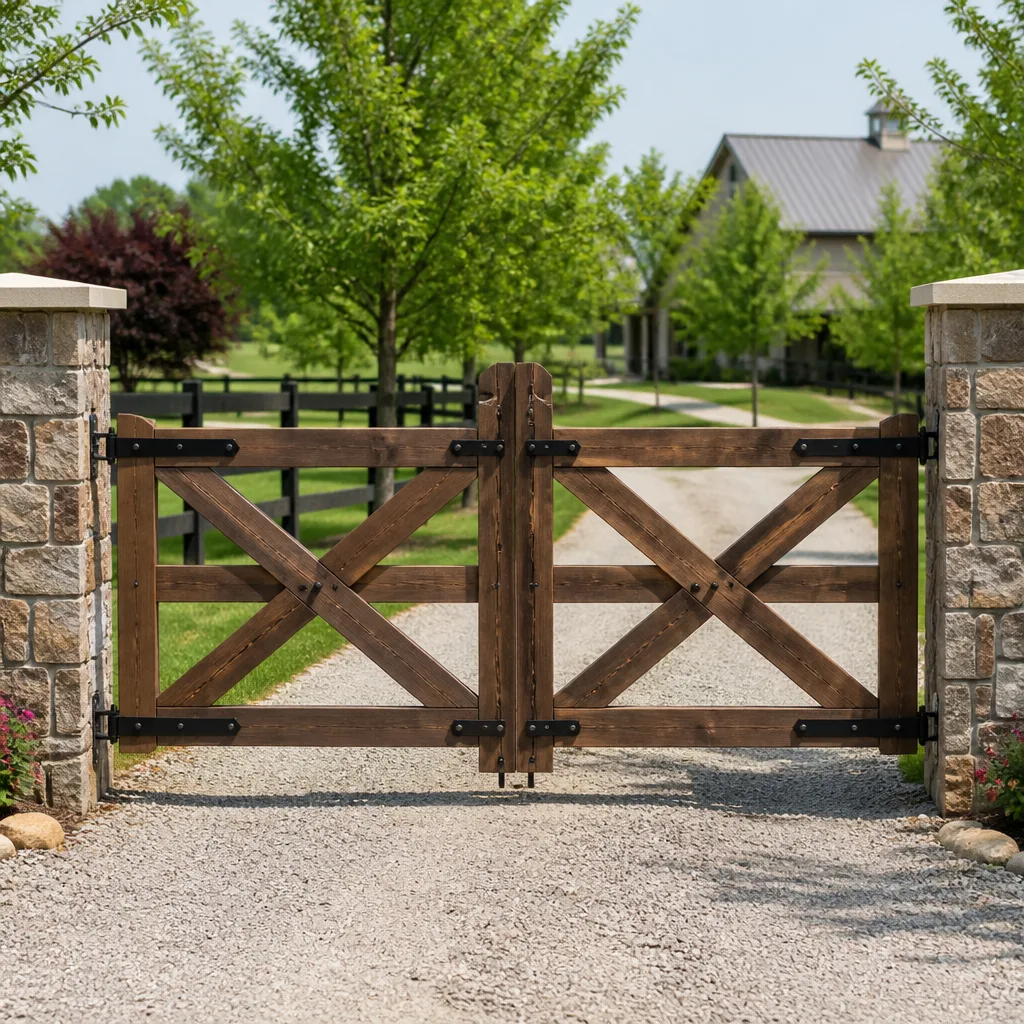 Farm & ranch
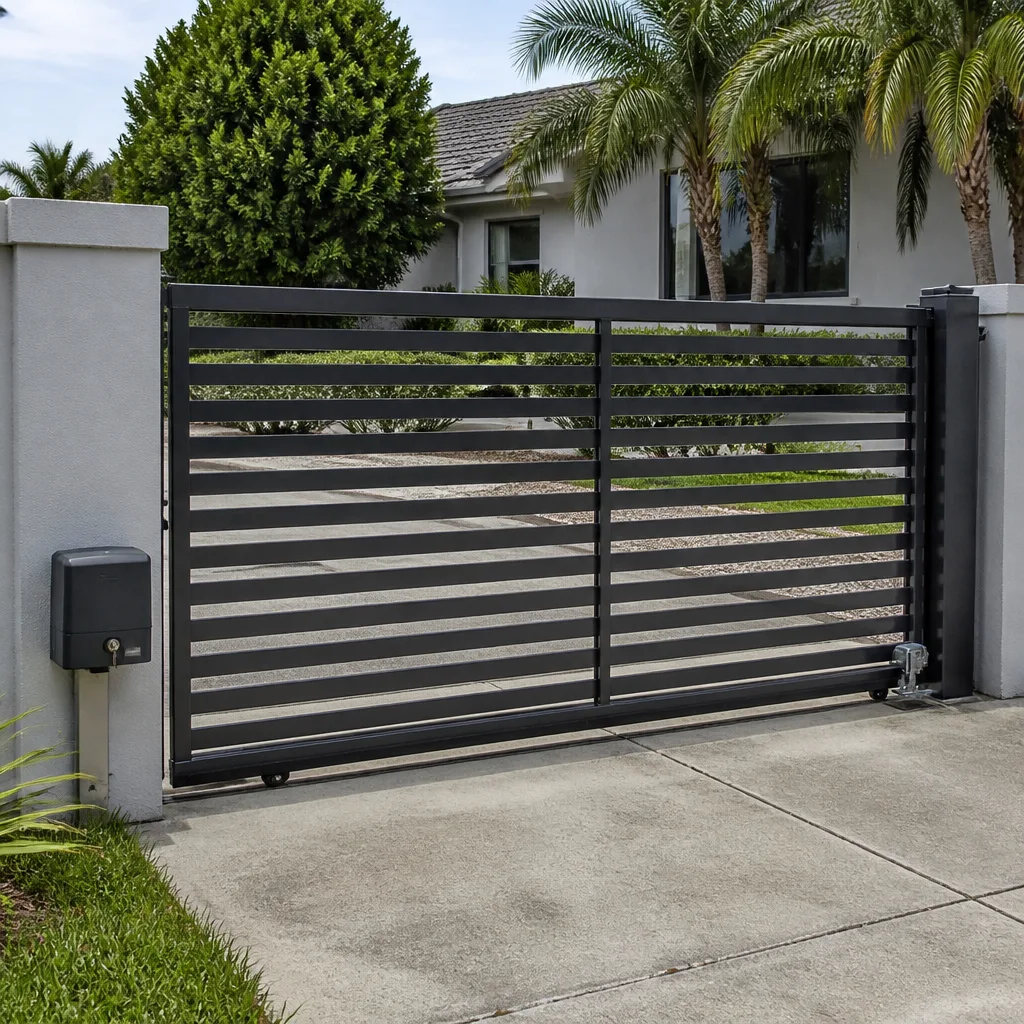 Sliding driveway gates
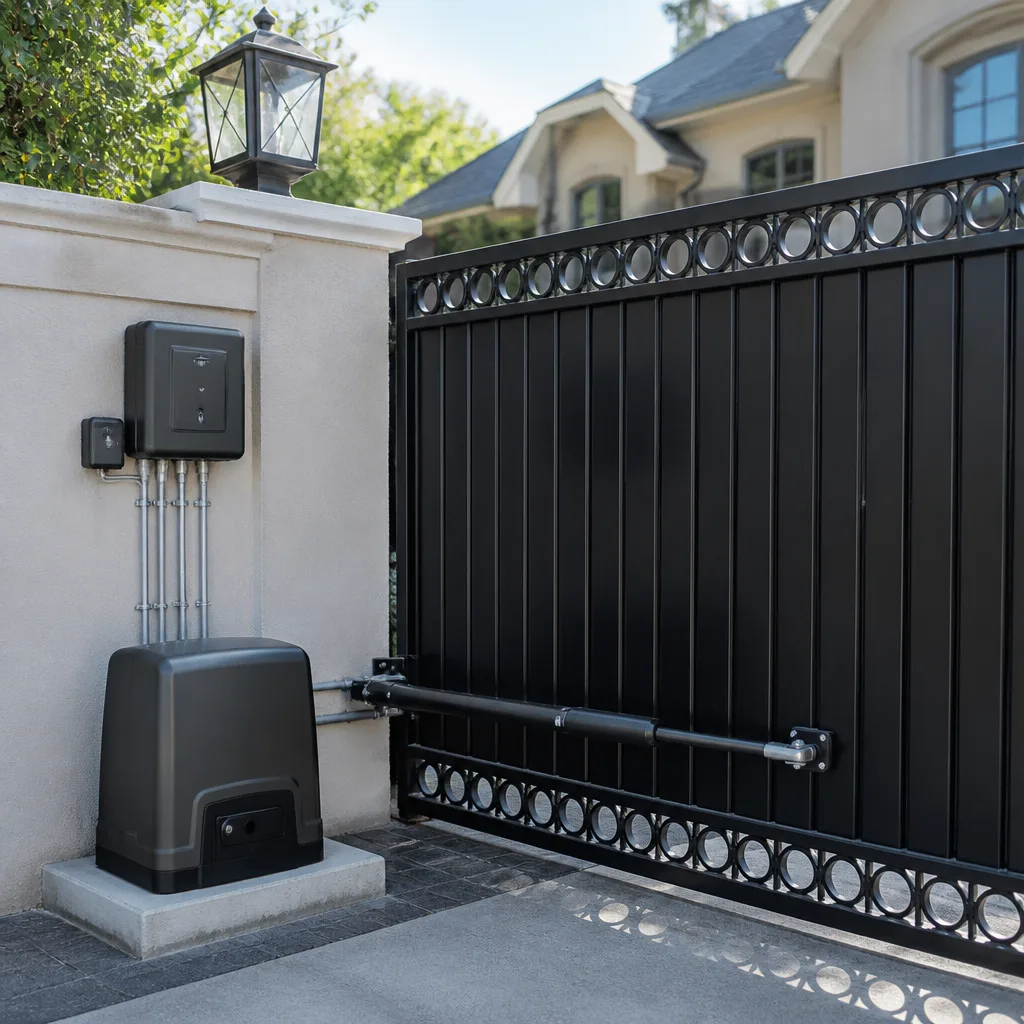 LiftMaster operators
Free on-site gate assessment - hinges, posts, and your LiftMaster or Nice gate operator checked before anything is quoted
The assessment is free and the quote is the invoice.
Get your free estimateGate Repair Maintenance Checklist for Fort Myers Homeowners
Most gate operators in Fort Myers don’t die from old age. They die from neglect that looks harmless until the moment it isn’t. The most common failure we see isn’t a stripped gear or a burned-out motor. It’s a $12 limit switch destroyed by corrosion because a weather seal went unchecked for two seasons. Here’s the counterintuitive part: in Fort Myers, the gate that gets a 10-minute inspection every month costs less to own than the gate that gets a full service call once a year. This checklist gives you both – the monthly ten-minute pass and the seasonal deep work that matches how this city actually wears on equipment.
Quick Answer
A Fort Myers gate maintenance checklist should be built around monthly visual and lubrication passes, quarterly battery and corrosion checks, and two mandatory seasonal deep inspections – June, before hurricane season peaks, and October, after storm surge and salt exposure have done their damage. The five highest-wear points in this climate are hinge pins, wheel bearings, the operator arm, the limit switch housing, and the battery terminals.
Styles & brands we work with
Table of Contents
- The 10-Minute Monthly Fort Myers Gate Checklist
- The Fort Myers Stress Calendar: Why Timing Matters More Than Frequency
- The Five Lubrication Points Fort Myers Humidity Demands Every 90 Days
- Battery Backup: Test It Before the Storm, Not After
- Coastal Corrosion: What to Check on Aluminum, Wrought Iron, and Steel Gates
- The Photo Log Method: Documenting Wear Without a Service Call
- Post-Storm Inspection: The October Recovery Pass
- The Snowbird Surge: Why Winter Cyclers Fail in January
The 10-Minute Monthly Fort Myers Gate Checklist
This is the pass you can do on a Saturday morning with a can of lubricant and your phone camera. It will catch 80% of the failures we get called out for, and it works for every brand of operator on the market. Whether you’ve got a LiftMaster arm, a FAAC board, or a Mighty Mule swing system, the physical wear points are the same.
Walk through these ten steps in order. Each one takes about a minute.
- Open and close the gate manually once. Use the release mechanism on the operator. The gate should move smoothly with even resistance. If you feel a catch, a grind, or a spot where it hangs, note where it happens.
- Listen to the operator while it runs a full cycle. A healthy motor hums steadily. A whine, a rattle, or a thunk during the travel arc tells you something is loading up.
- Check the limit switch action. The gate should stop flush with its closed stop and fully clear its opening. If it slams at the end or reverses early, the limit adjustment is drifting.
- Inspect the safety edges and photocells. On Fort Myers gates, salt haze and spider webs are the two things that blind optical sensors. Wipe the photocell lenses with a dry cloth. Test the edges by applying pressure while the gate closes.
- Look at the hinge pins. Top and bottom, both leaves. Move the gate slightly and watch for any vertical play at the pin. Play at the hinge is the number-one cause of gate sag in Fort Myers.
- Check the operator arm attachment bolts. These bolts come loose on swing gates more than any other fastener on the property. Two minutes with a socket wrench now saves a torn bracket later.
- Clear the track or travel path. For slide gates, run your hand along the top of the rail. Any pebble, palm frond, or acorn will bind the wheels. Clear the entire travel zone.
- Wipe down the control board housing. Dust, gecko droppings, and condensation residue all conduct electricity where they shouldn’t. A dry wipe every month prevents corrosion creep on the board.
- Check the battery indicator, if equipped. Look for the little LED or gauge. If it’s amber or red, note it. You’ll want to test that battery soon.
- Photograph anything that looks different. Rust bloom, a crack in a weld, a sagging corner, a wheel that’s picked up wear. Two photos, same angle, kept in a folder.
That’s the monthly pass. In our experience with Fort Myers gates, it prevents about 80% of the service calls we run. The remaining 20% are electrical failures and seasonal wear that the next sections cover.
The Fort Myers Stress Calendar: Why Timing Matters More Than Frequency
Generic maintenance advice says inspect your gate twice a year. That advice was never written for a city where June through November brings 70% of the annual rainfall, where salt spray travels miles inland on sea breeze days, and where December brings a sudden population spike as seasonal residents return. Fort Myers has a stress calendar, and it dictates when certain maintenance tasks stop being optional.
Here’s the month-by-month map we recommend for automated gates in Lee County.
January through April: The Dry Season Window
This is your best maintenance weather. Low humidity, mild temperatures, and the equipment is running at lower stress. This is the window for any mechanical work that requires disassembly, painting, or sealant cure time. It’s also the stretch when snowbird traffic peaks, so operator duty cycles are high even though the weather is mild.
May: Start the Pre-Season Checklist
By mid-May, the afternoon thunderstorms have started. Humidity climbs. Anything you didn’t lubricate or seal in the dry season is about to pay the price. This is when we start seeing the first corrosion-related failures of the year.
June: The Mandatory Pre-Hurricane Pass
Before June 1st, every Fort Myers gate should get the full inspection. Battery backup gets tested under load. Seals get checked. Bolts get torqued. The gate needs to be able to run off battery power for multiple cycles, because that’s exactly what will be asked of it if the grid goes down. We cover this in detail below.
July through September: Weekly Watch
During peak storm months, change the monthly pass to a weekly pass. You’re not doing deep work. You’re watching for new issues: water in the housing, corrosion bloom, debris in the travel path, operator behaving differently after a power flicker.
October: The Post-Storm Recovery Inspection
After the last storm threat passes, do the full inspection again. This pass catches salt intrusion, water damage, and stress cracks that formed during high winds. It also resets the maintenance clock for the winter surge.
November and December: The Snowbird Ramp
Seasonal homes come back online. Gates that sat idle through the summer suddenly run 20 to 40 cycles a day. November is the month to change operator oil if you have a hydraulic unit, and to re-torque everything before the workload spike. This is also when batteries that degraded over the hot summer show their weakness, because the charger can’t keep up with cold-morning starts.
The point of this calendar isn’t to add work. It’s to put the work you already do into the month where it actually prevents failures. A lubrication pass in February is maintenance. The same pass in June is insurance.
The Five Lubrication Points Fort Myers Humidity Demands Every 90 Days
National maintenance guides say lubricate gate hardware annually. That advice fails in Fort Myers for one reason: humidity doesn’t just accelerate corrosion, it degrades lubricant faster. Grease breaks down. Oil gets diluted by condensation. Dry lubricant films wash away faster in sea air. We’ve pulled apart hinges that were lubricated eight months prior and found bare metal with rust bloom already forming.
Every ninety days, hit these five points. Use a lithium-based grease for the first three, a silicone spray for the fourth, and a dielectric grease for the fifth.
- Hinge pins, top and bottom, on every leaf. This is the highest-loaded wear point on any swing gate. Work the grease into the pin by moving the gate back and forth a few inches while you apply it.
- Slide gate wheel bearings. These sit low, which means they catch splash from every rain. Pop the bearing caps if they’re accessible. If they’re sealed, apply grease at the axle points.
- The operator arm pivot joints. On LiftMaster, FAAC, and BFT arm units, there are two or three pivot points that articulate with every cycle. These load and unload constantly and dry out fast in coastal air.
- The track surface for slide gates. A light silicone coat on the top rail reduces wheel friction and displaces water. Don’t use grease here. Grease catches sand and salt crystals and turns the track into grinding paste.
- Battery terminals. Every battery backup system has exposed terminals unless the installer properly sealed them. A thin coat of dielectric grease on the posts prevents the green corrosion that kills batteries in Fort Myers.
Here’s the part most checklists leave out: after the 90-day lubrication pass, run the gate through five full cycles to work the lubricant into the loaded surfaces. Then wipe off any excess. Extra grease on the outside of a hinge just collects salt and sand. The lubricant that matters is the film between the surfaces, not the visible glob.
If you’re uncomfortable working around the operator mechanism itself, have a gate technician handle the arm and pivot work. These are not dangerous components the way springs are, but incorrect lubrication of an electric actuator can force grease into a motor housing where it doesn’t belong. For the homeowner pass, the hinge pins and visible pivots are the safe, high-value targets. We do a full lubrication pass on every gate repair and maintenance visit in Fort Myers.
Battery Backup: Test It Before the Storm, Not After
Most gate operators fail within 72 hours of a power restoration surge after a storm. That’s the failure mode that catches people. The storm passes, the grid kicks back on, and the surge hits the operator board while the homeowner assumes everything is fine. By the time the gate stops working days later, the original cause is invisible.
A battery backup system changes that equation. It protects the operator from grid instability and keeps the gate running when the power drops. But only if the battery is healthy. In Fort Myers, we recommend testing backup batteries every quarter, with the mandatory test happening before June 1st.
Here’s the test sequence.
- Read the battery date code. Most gate backup batteries are sealed lead-acid or gel batteries with a 3-5 year service life. If the battery is over 3 years old and has not been tested recently, it’s suspect.
- Check the terminal condition. Remove the terminal covers. Look for white or green corrosion around the posts and cable lugs. White powder is oxidation. Green is copper corrosion. Both signal resistance and heat buildup.
- Run a load test. The correct way isn’t checking voltage with a multimeter. A battery can read 12.6 volts and collapse under load. The proper test: turn off the circuit breaker that powers the operator, then run the gate through ten full cycles on battery power alone. A healthy battery does this without slowing down. A weak battery starts lagging by cycle five or six.
- Recharge and recheck. Turn the breaker back on and let the charger run for eight hours. Then run two more cycles. If the battery was slow in the load test, it needs replacing regardless of how it behaves after a recharge.
- Log the results. Write the date, the battery’s age, and the number of cycles completed on a piece of masking tape stuck to the battery housing. That log becomes invaluable when a technician needs to know whether this battery is on its first or fourth Fort Myers summer.
One thing we’ve seen repeatedly: batteries in Fort Myers die young, especially in coastal zip codes. Heat is the killer. A battery sitting in a metal housing in a Florida afternoon hits well over 100 degrees Fahrenheit, and that temperature accelerates internal degradation. If your operator housing sits in direct sun, adding a sun shade or planting a shrub on the western side (while keeping clearance for airflow) extends backup battery life measurably. We replace backup batteries on electric gate systems around Fort Myers more often than almost any other single component.
Coastal Corrosion: What to Check on Aluminum, Wrought Iron, and Steel Gates
Fort Myers is a salt environment. You already know that if you live here. But the wear pattern depends heavily on what your gate is made of, and the maintenance response is different for each material. A blanket “check for rust” instruction misses most of the actual failures.
Aluminum Gates
Aluminum doesn’t rust, which is why it’s the most common gate material in Fort Myers and the surrounding communities. But it has a specific corrosion failure called galvanic corrosion. It happens where aluminum touches a different metal, like a steel hinge pin or a stainless bolt, in the presence of salt moisture. The aluminum loses material at the contact point, and the joint loosens over time.
What to check on aluminum gates: every hinge, every bolt hole, every place a steel fastener passes through aluminum. Look for a white powdery substance around the fastener. That’s aluminum oxide, and it means the joint is actively corroding. The fix is usually a replacement of the fastener with an isolated or coated equivalent, plus sealing the joint.
Wrought Iron Gates
True wrought iron is rare in modern installation. Most gates sold as “wrought iron” in Fort Myers are actually formed steel. On these gates, rust starts at the joints and welds, not on the flat surfaces. Water sits in the crevices where two bars meet, and that’s where the coating fails first.
What to check on wrought iron or steel gates: every weld seam, every scroll joint, every place the finish has a small crack or chip. Rust at a weld is structural. On a swing gate, a corroded weld at the top hinge mount will eventually shear. Tap suspect welds with a wrench. Solid metal rings. A corroded weld sounds dull. If you find rust bloom on a weld, sand it back and re-seal, or call a tech to evaluate whether the weld needs re-work.
Steel Slide Gate Frames
Most slide gates in Fort Myers are steel frames with aluminum or vinyl infill. The vulnerable point on these is the bottom track rail and the wheel mounting brackets, which sit permanently in the splash zone. Check for scale rust anywhere below the 12-inch line. Surface rust can be treated. Deep scale means the steel is thinning, and on a gate that’s ten years old or older in a coastal zip code, the fix is often a new frame section rather than a patch.
The geographic reality: homes within three miles of the Caloosahatchee or the Gulf see corrosion rates roughly double what inland neighborhoods experience. We treat every gate within that coastal band with a more aggressive maintenance schedule. A gate in Gateway or Three Oaks might go five years between paint touch-ups. The same gate on McGregor Boulevard or in an Isles community might need paint every two to three years.
The Photo Log Method: Documenting Wear Without a Service Call
This is the most valuable habit a Fort Myers homeowner can build, and almost nobody does it. A photo log turns maintenance from guesswork into data. When a technician arrives with a problem, the first question is always “when did this start changing?” A photo log answers that question precisely.
Here’s how to set it up.
- Create a folder on your phone named “Gate.” That’s it. Whatever cloud service you use, the folder name is the same.
- Photograph six specific points every month, same angle each time: the bottom hinge assembly on each leaf, the top hinge on each leaf, the operator arm connection point, the limit switch area, the battery terminals, and a full-width shot of the gate in the closed position.
- Note the cycle count if your operator displays one. LiftMaster and some BFT units track total cycles. If yours does, write the number in the photo caption or a note file. Cycle count matters because it tells a technician how much life the motor and gearbox have already used.
- Photograph any new sound’s location. If the gate starts making noise, record a short video from a few feet away, then photograph the area you think the sound came from. Sound recordings are diagnostic gold for an experienced ear.
- Log the maintenance tasks you perform. One line in a notes file: “Feb 12 – greased hinges, cleaned sensors, battery test 9 cycles.” Ten seconds of note-taking now replaces a full diagnostic charge later.
The payback comes when something fails. A technician can compare today’s photo against the photo from three months ago and see exactly when a wheel started wearing, when a weld started cracking, or when a limit switch housing began corroding. That’s interval-based diagnosis, and it’s the difference between a targeted fix and an exploratory tear-down. We can often identify the failure source over the phone using a client’s photo log, and that means the service visit is faster and cheaper. It also helps when we’re analyzing whether an existing gate is worth repairing or replacing during a gate installation consultation in Fort Myers.
Post-Storm Inspection: The October Recovery Pass
After hurricane season, every gate in Fort Myers needs a specific recovery inspection. The monthly checklist isn’t enough here, because the October pass looks for damage that storms cause in ways the monthly pass wasn’t designed to catch.
Start with these items.
- Water intrusion in the operator housing. Open the housing and look for condensation, standing water, or a high-water line. Even if the board works today, trapped moisture will corrode the circuit traces over the following months. Dry the housing thoroughly and inspect the gasket or seal.
- Salt film on everything. After a major storm, a fine salt haze settles on every surface. On electrical contacts and circuit boards, that film conducts electricity where it shouldn’t. Wipe boards and connectors down with a clean dry cloth. Don’t use water or harsh cleaners on electronics.
- Stress cracks at welds and bolt holes. Hurricane-force wind loads gates in directions they were never designed to bear. On swing gates, the wind pushes and pulls on the leaf, concentrating stress at the hinge mounts and the operator connection. Inspect those welds closely. A hairline crack in October is a sheared gate by February.
- Track and wheel displacement on slide gates. Flood water and debris can move a slide gate’s track mounts by fractions of an inch. The gate still works, but it’s now running slightly out of alignment, which accelerates wheel wear. Check wheel contact with the track across the full travel.
- Battery condition after the storm. If the battery carried multiple cycles during an outage, it may have been deeply drained. Deep-cycle batteries that get fully discharged repeatedly lose capacity quickly. Run the load test again and compare results to your June log.
- Debris accumulation in the travel path. Storms rearrange landscaping. A gate that cleared its path perfectly in May might now be clipping a root, a paver, or a newly settled fence post. Walk the full travel path and look for new contact.
The October pass resets your maintenance baseline. Everything you document here becomes the starting point for the dry season, and it’s the best time to schedule any repair work that accumulated during the summer months.
The Snowbird Surge: Why Winter Cyclers Fail in January
Every January, Fort Myers gate repair call volume spikes. The reason is not the weather. It’s the duty cycle. Seasonal residents return, and gates that ran ten cycles a day through the summer suddenly run forty or fifty. Operator motors, gears, and boards that handled the light load without complaint get pushed past their degraded capacity.
Here’s what changes when a seasonal home comes back online.
- Cycles climb 300 to 500 percent overnight. Each cycle loads the motor, the gear train, the hinges, and the limit switches. A component that was marginal in October fails within weeks of the increase.
- Resistance changes with temperature. Older lubricants thicken in cooler temperatures, especially early mornings. A gate that ran fine in August’s 85-degree morning might strain at 55 degrees with six-month-old grease. This is another argument for the 90-day lubrication schedule we outlined above.
- Batteries exposed by cold starts. Batteries lose capacity in cooler temperatures. A backup battery that tested at 80% capacity in June might deliver 60% in January. Combined with the already-degraded state from summer heat, this is the second-worst time of year for battery failure.
- Limit switch drift shows up under high use. Limit switches wear gradually with each cycle. A snowbird surge accelerates that wear dramatically. Gates that stop short, slam, or reverse unexpectedly are usually telling you the limit switch is worn or misadjusted.
- Photo cell misalignment from landscaping changes. If new plantings or moved furniture shifted the photocell alignment, the seasonal traffic increase makes the resulting faults more frequent and more annoying. Check sensor alignment in December before the busy period.
If you own a seasonal home in Fort Myers, put the October recovery pass and a November lubrication pass on your arrival checklist. Better, schedule a service visit before the season starts so the gate is ready when you arrive. We handle a lot of pre-season checks on electric gates, including LiftMaster, BFT, and Mighty Mule systems, and the customers who schedule them are not the ones calling us with failures in January.
Common Mistakes to Avoid
- Lubricating according to a national schedule. Once-a-year lubrication is a northern recommendation. In Fort Myers humidity and salt air, lubricant films fail in 90 days. Your hardware is running dry for the last eight months of that national schedule.
- Testing the battery by checking voltage only. Voltage is a resting measurement. It tells you nothing about the battery’s ability to deliver current under load. The ten-cycle load test is the only test that predicts real-world backup performance.
- Ignoring a new sound. A gate that starts making a noise it didn’t make before is telling you something is changing. The sound is the early warning. Waiting until the sound becomes a failure means paying for a part replacement that could have been a $10 adjustment.
- Painting over rust on a steel gate without treating the surface. Rust continues under paint. If you don’t remove the oxidation and treat the surface, the new paint just hides the failure for another season. Then the failure is bigger and more structural when it reappears.
- Using WD-40 as a lubricant. WD-40 is a water displacer and cleaner, not a lasting lubricant. It’s useful for freeing a stuck part, but it evaporates within days. Using it as hinge lube in Fort Myers leaves your hinges dry and unprotected against salt air. Use lithium grease.
- Waiting for the gate to stop working before calling for service. By the time a gate fails completely, the root cause has usually been developing for weeks or months. The maintenance pass is designed to catch those developing failures while they’re still cheap to fix.
- Replacing the operator when the problem is mechanical. We see this constantly. A gate drags because a hinge is worn or a wheel has bound up. The operator works harder to compensate, and eventually the operator fails. Replacing the operator without fixing the mechanical resistance just ruins a new operator on the same underlying problem. Diagnose the real cause first.
See the difference
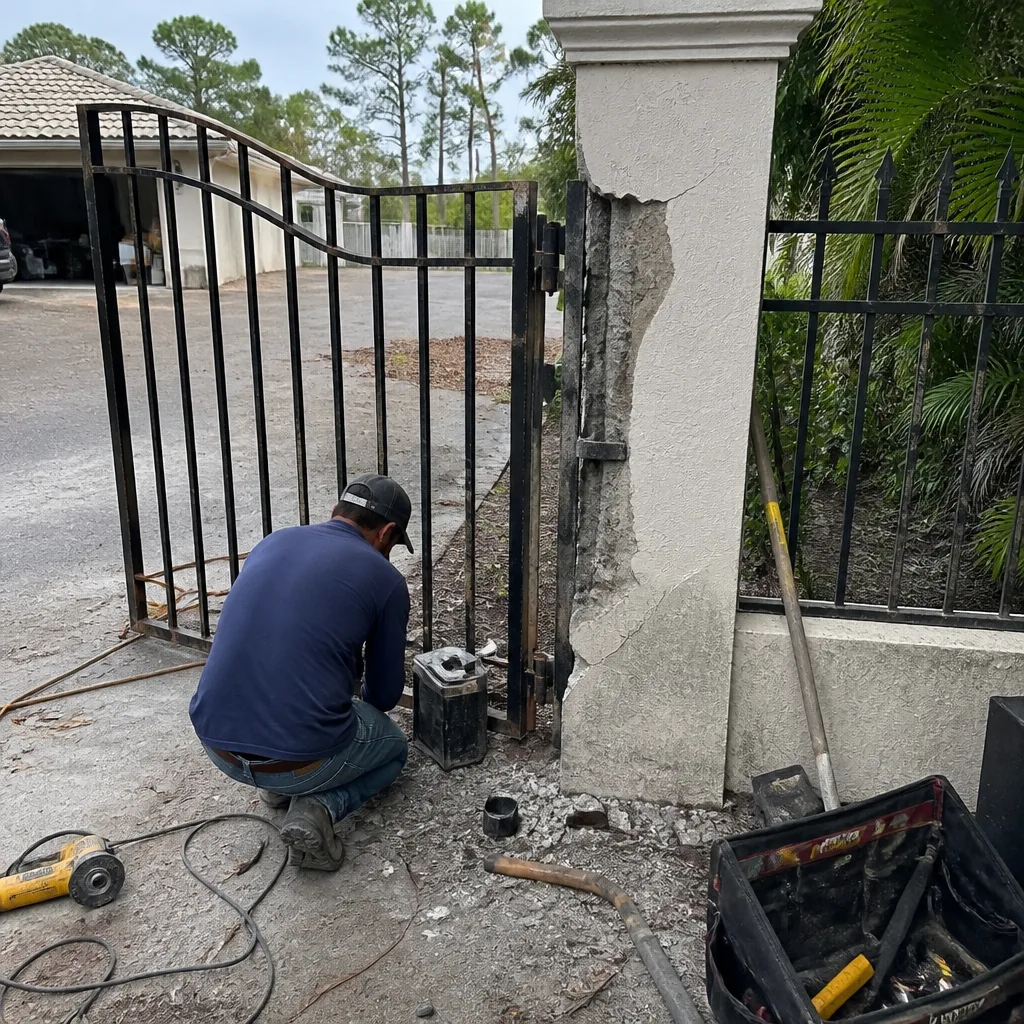 Before
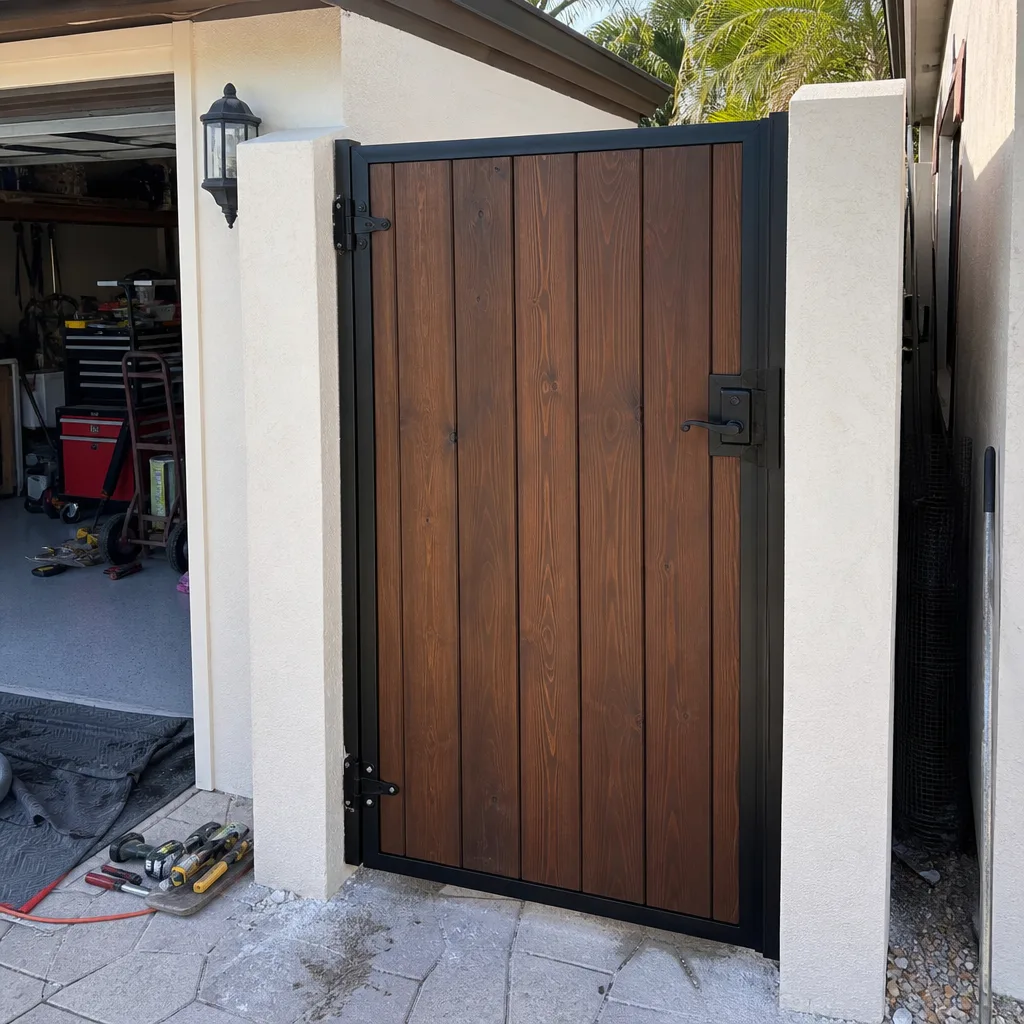 After
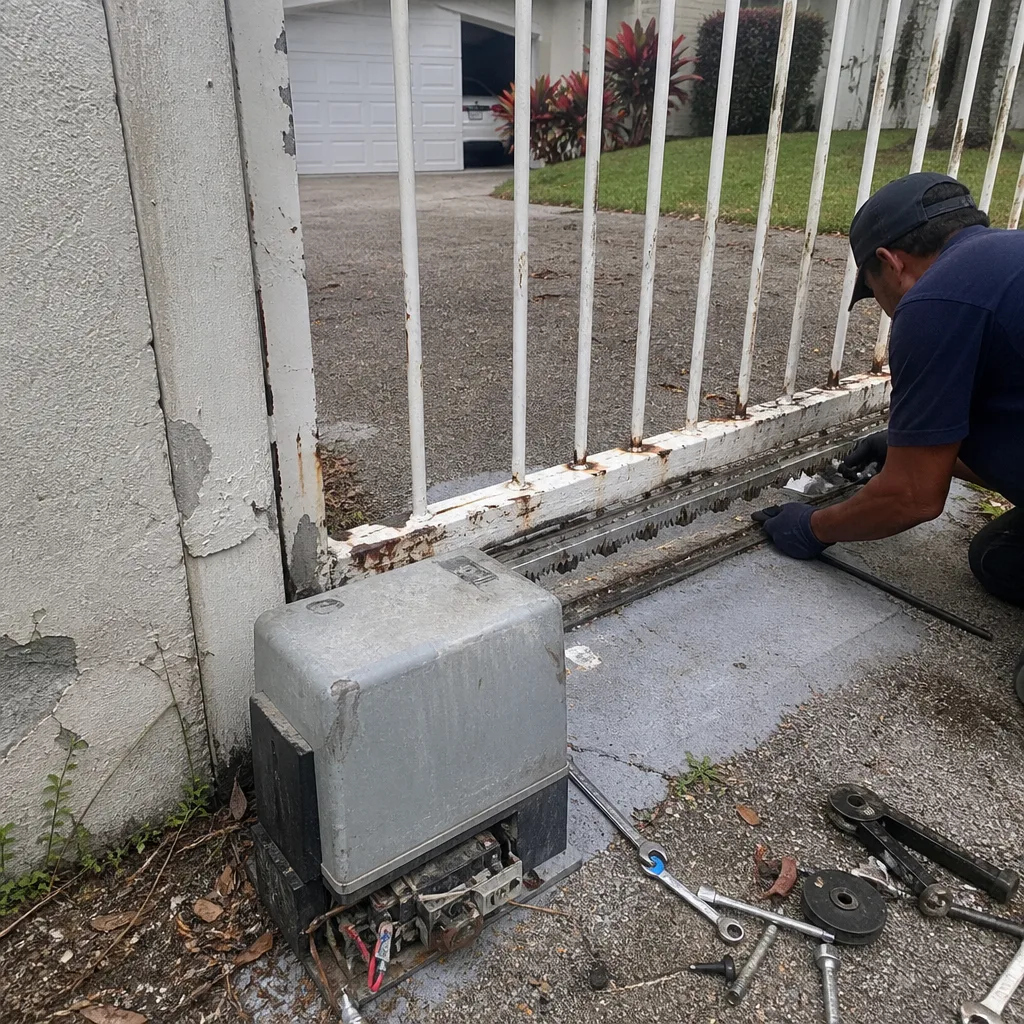 Before
 After
 Before
 After
When to Call a Professional
Some maintenance tasks are homeowner work. Others cross into territory where a specialist saves you money and prevents injury. Call a gate technician when you see weld cracks at structural joints, when you hear gear grinding inside the operator housing, when the gate has come off its track, when the limit switches need adjustment beyond the visible stop positions, or when water has entered the control board housing. These conditions involve spring-loaded components, high-voltage wiring, or structural failure that can turn a small part into a major injury if handled incorrectly. Courtyard Gate Repair offers free estimates in Fort Myers – call (844) 791-3898 to schedule a maintenance visit or a diagnostic call.
Frequently Asked Questions
A standard maintenance visit for a residential automatic gate in Fort Myers typically runs between $125 and $225 depending on the gate type, operator brand, and what needs servicing. Battery replacement, part replacement, and corrosion repair are additional. The cost of a maintenance visit is almost always less than the cost of an emergency repair, and regular maintenance extends operator life by years. Call us at (844) 791-3898 for an exact quote – estimates are free.
Every 90 days, year-round. The humidity and salt air in Fort Myers degrade lubricants roughly three times faster than the national average climate, so the annual lubrication advice written for northern states leaves your hinges running dry for most of the year. Use lithium grease on hinge pins, wheel bearings, and operator pivots, and silicone spray on slide gate tracks.
Yes, the monthly pass and the lubrication pass are safe for homeowners who can operate a wrench and a grease gun. The battery load test is also safe. What you should not attempt is limit switch adjustment on an unfamiliar operator, spring tension adjustment, or any work inside the control board housing where high voltage is present. Those are professional tasks.
Storm-related gate failures in Fort Myers typically come from one of three causes: a power surge that damaged the operator board, water intrusion into the housing that caused delayed corrosion, or wind loading that cracked a weld or loosened a hinge. The pre-season pass catches the conditions that allow these failures, and the post-storm recovery pass finds the damage before it becomes a total failure.
With proper maintenance, a quality residential gate operator in Fort Myers lasts 8 to 12 years on average. Without maintenance, the same operator often fails in 4 to 6 years, and coastal salt exposure shortens that further. The operator’s cycle count and brand matter too. Higher-cycle commercial units like some FAAC and BFT models are built for more total cycles than entry-level residential units.
Yes, a healthy backup battery will run an automatic gate through multiple cycles during a grid outage, which is exactly what Fort Myers homeowners need after a hurricane. The key word is healthy. Backup batteries degrade faster in Florida heat, and many homeowners discover a dead battery at the worst possible time. The quarterly load test described above is the only way to know your battery will perform when you need it. If your battery is over three years old and hasn’t been load-tested, assume it’s due for replacement.
The Bottom Line
A Fort Myers gate doesn’t need constant attention. It needs the right attention at the right times. Monthly visual checks catch early wear. Quarterly lubrication keeps the salt and humidity from eating your hardware. The June pre-storm pass makes your gate ready for what the Gulf can throw at it. The October recovery pass finds the hidden damage before it compounds. And a simple photo log turns all of that effort into a maintenance history that makes any future repair faster, cheaper, and more precise. For more guides & resources on protecting your gate, browse our blog. The homeowners who follow this calendar aren’t the ones we hear from at 7 a.m. with a gate stuck open and a car trapped inside. The ones who skip it are.
Written by the team at Courtyard Gate Repair, serving Fort Myers since 2017.