Last updated October 30, 2026
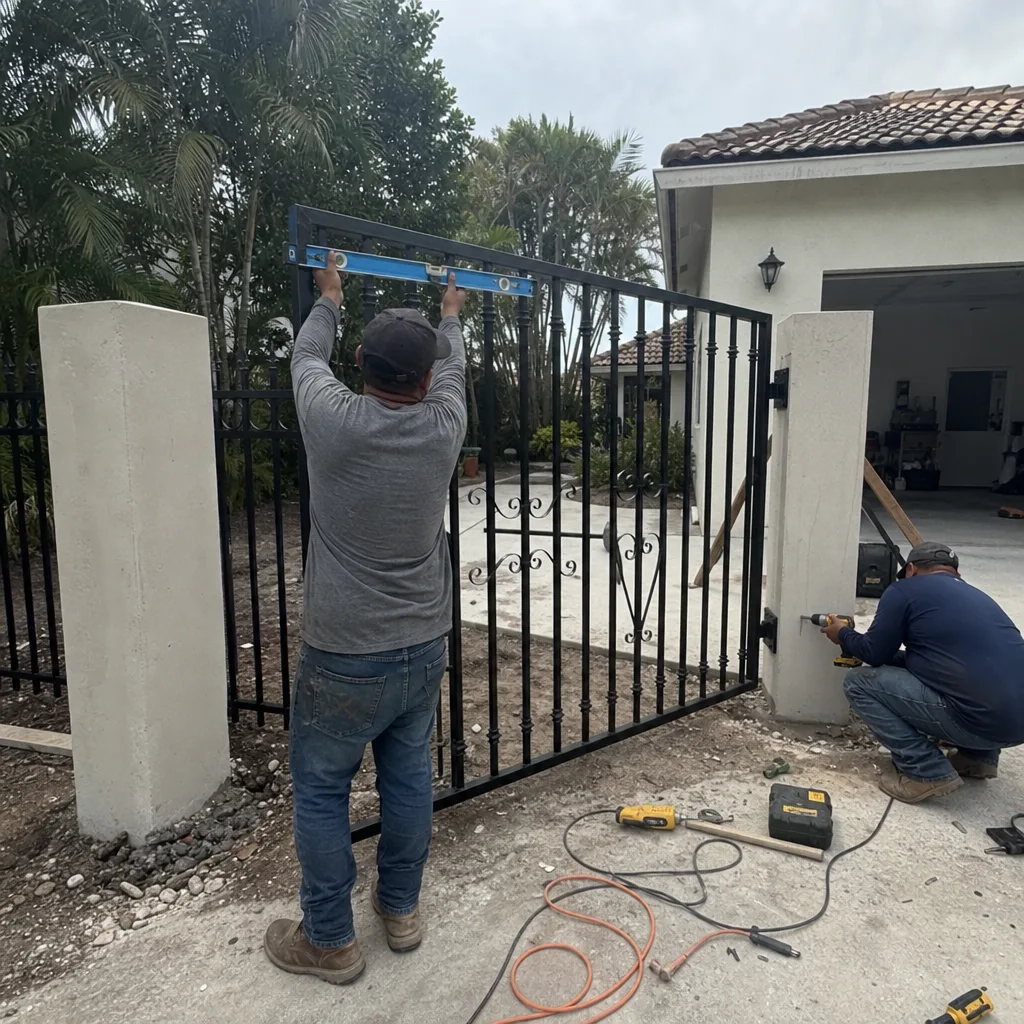
 Wrought iron
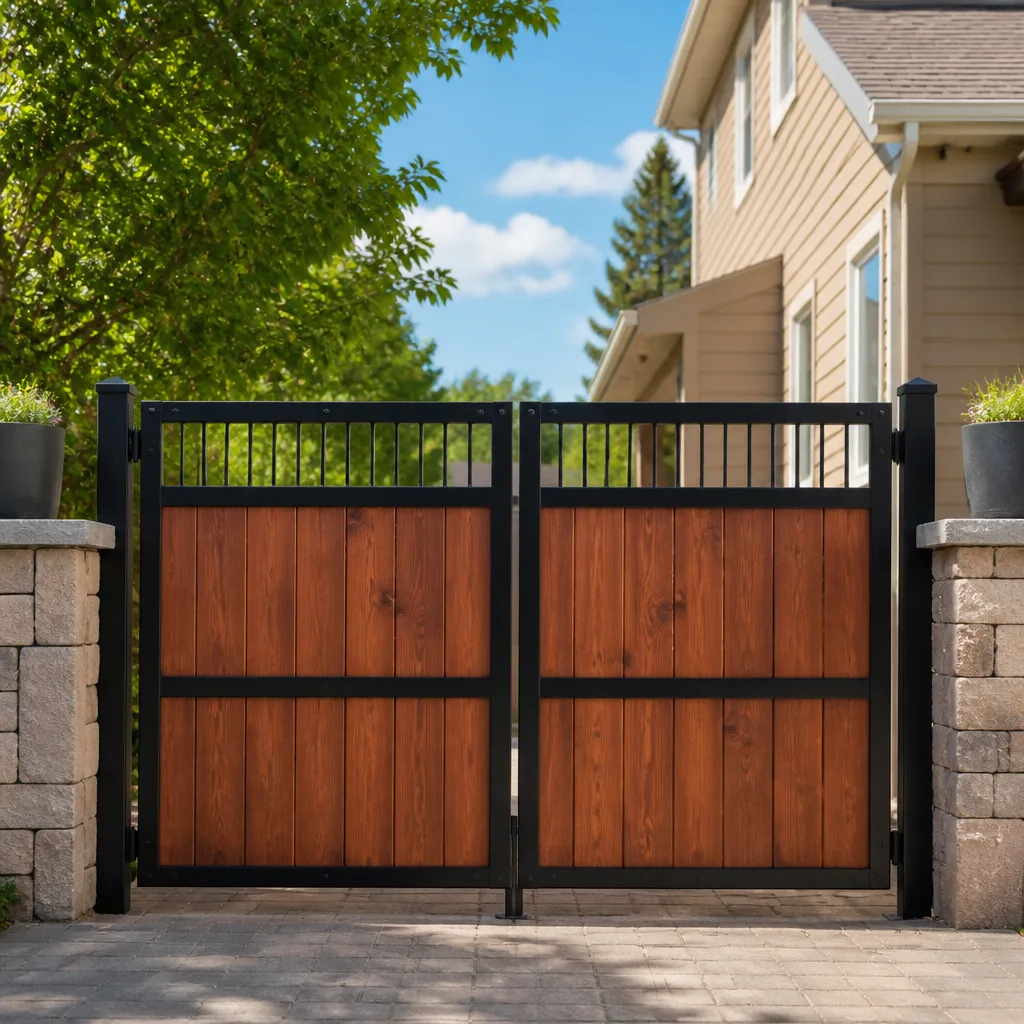 Wood & steel frame
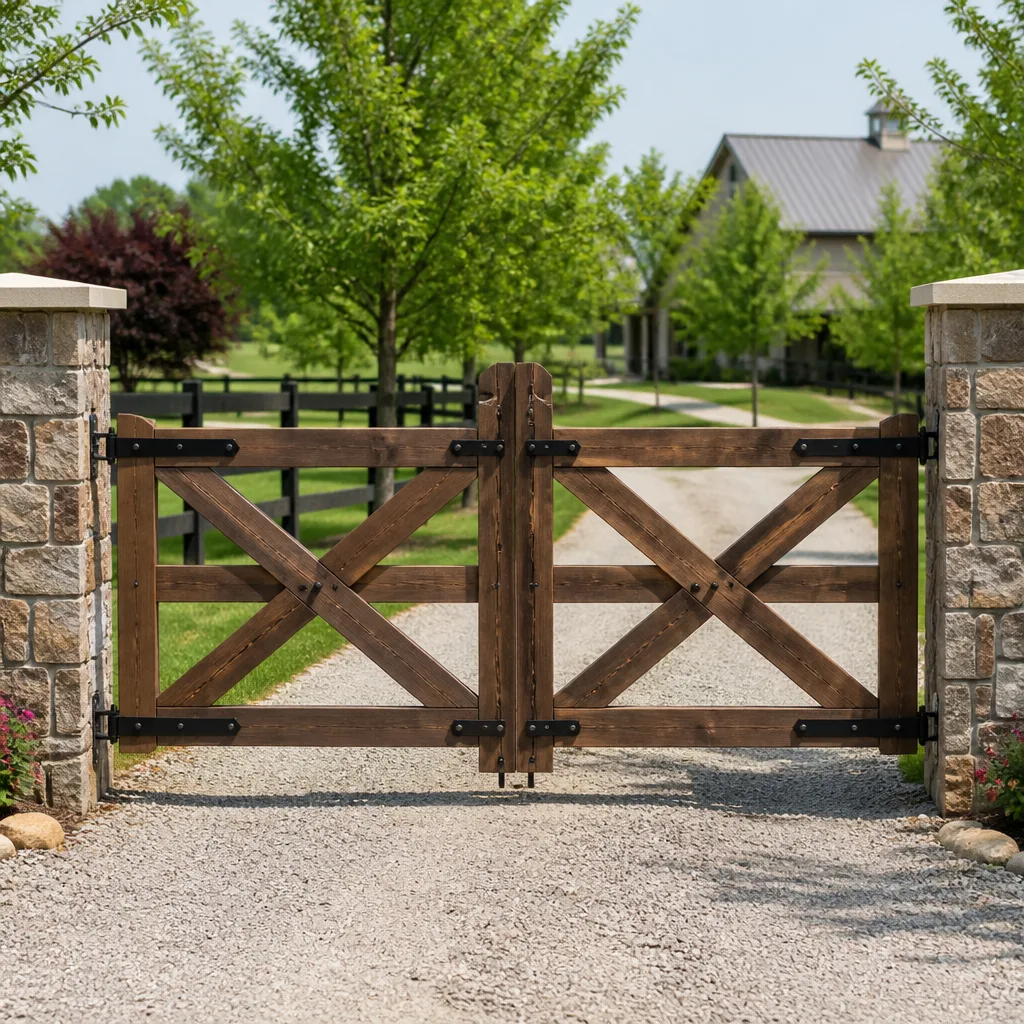 Farm & ranch
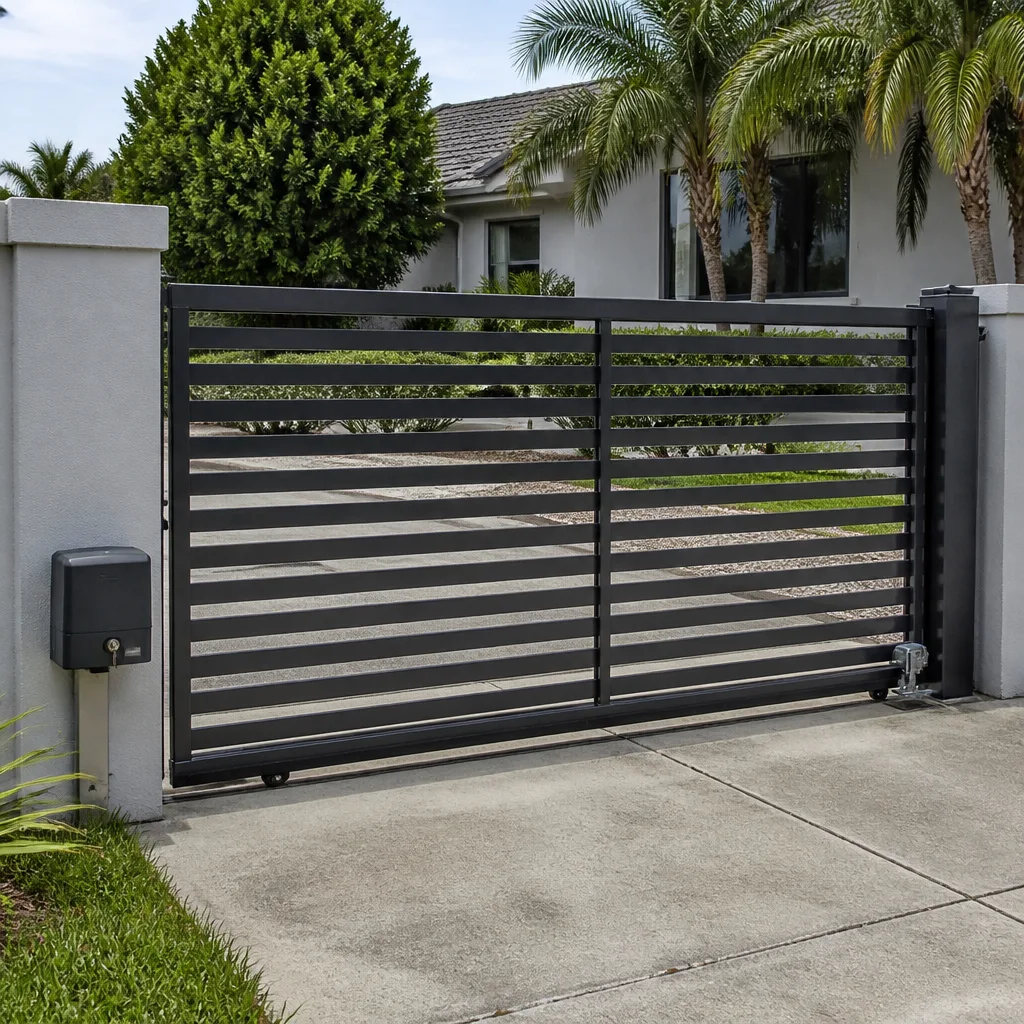 Sliding driveway gates
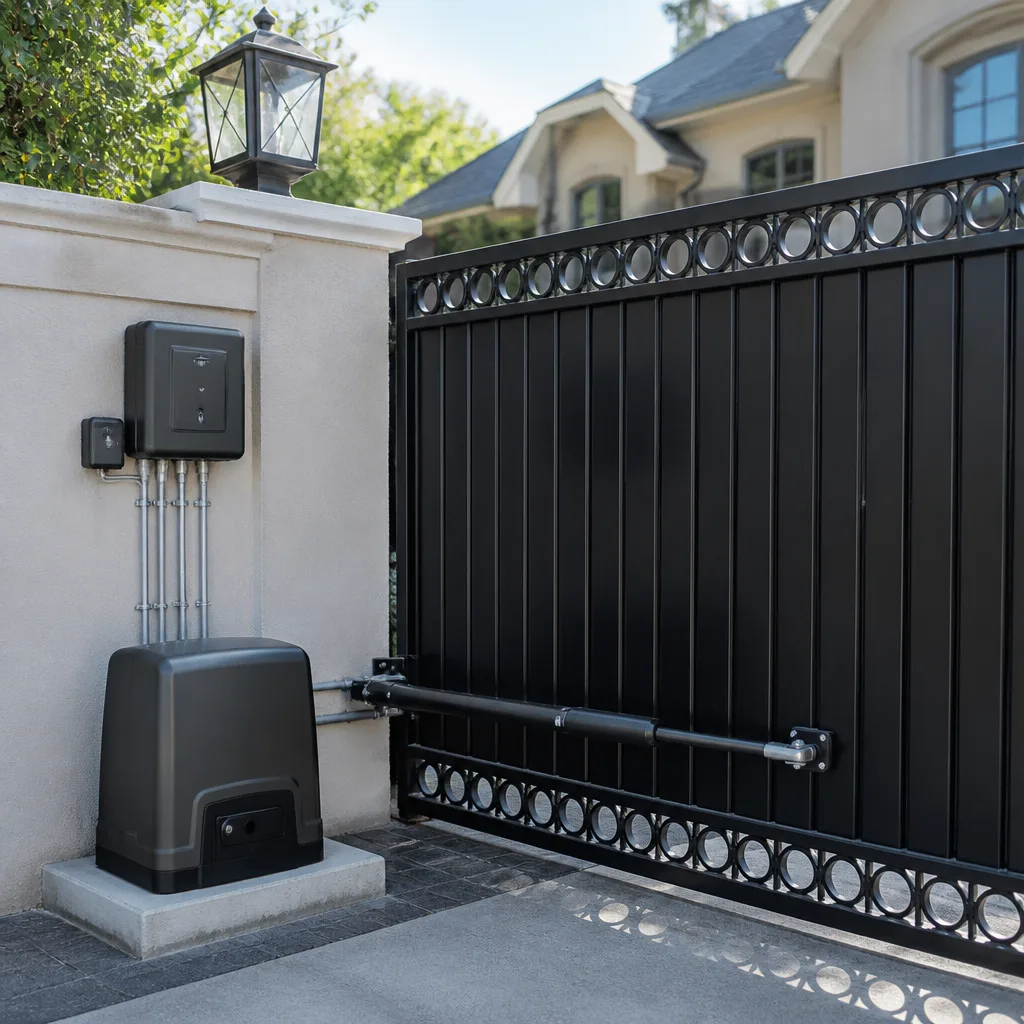 LiftMaster operators
Free on-site gate assessment - hinges, posts, and your LiftMaster or Nice gate operator checked before anything is quoted
The assessment is free and the quote is the invoice.
Get your free estimateHow to Hire a Gate Repair Contractor in Fort Myers: A Step-by-Step Guide
Fort Myers has a gate problem that most homeowners discover too late. A contractor licensed to install a LiftMaster operator is not automatically qualified to diagnose why your Mighty Mule board is dropping signal, yet both will answer the same Google search when your gate stops opening. The result? Homeowners pay for a “repair” that holds for six months, then fails again because the root cause was never found. This guide walks you through exactly how to vet a our Gate Repair services contractor in Fort Myers so the person you hire actually fixes the problem, not just the symptom. You’ll learn the questions that separate brand-agnostic specialists from single-brand dealers posing as repair shops, what Florida licensing does and doesn’t tell you, and the contract terms that protect you when a repair goes sideways.
Quick Answer
To hire a gate repair contractor in Fort Myers, verify they have hands-on experience with your specific operator brand (not just the one they sell), ask for a written diagnostic before any replacement recommendation, confirm Florida licensing and insurance, and get contract terms in writing covering labor warranty, callback policy, and whether the diagnosis fee applies to repair cost. A qualified specialist will diagnose across multiple brands like LiftMaster, FAAC, BFT, Linear, Viking, Ghost Controls, DoorKing, Elite, and Mighty Mule rather than pushing a full system replacement. The right contractor can usually repair your existing equipment for substantially less than a new installation.
Styles & brands we work with
Table of Contents
- The Vetting Questions That Actually Matter
- What Florida Contractor Licensing Actually Covers for Gate Work
- Why Brand-Agnostic Diagnosis Matters More Than Brand Certification
- Red Flags in Quotes: When “Replace It” Is a Warning Sign
- How to Verify Gate Brand Experience Before Committing to a Service Call
- Contract Terms That Protect You: Labor Warranty, Callbacks, and Diagnosis Fees
- Fort Myers-Specific Considerations: Climate, Code, and Market Realities
- The Hiring Process: A 7-Step Walkthrough
The Vetting Questions That Actually Matter
Most homeowners ask the wrong questions when hiring a gate contractor. “Are you licensed?” and “How much do you charge?” are table stakes. They don’t tell you whether the person showing up can actually diagnose your specific system. After years of watching Fort Myers homeowners get burned by guesswork repairs, we’ve learned that the questions below separate real specialists from general contractors who happen to own a multimeter.
The first question to ask is simple: “What brands of gate operators have you worked on in the last 30 days?” Listen to the answer carefully. A single-brand dealer will name one manufacturer and talk about how great that brand is. A genuine specialist will list several, often with specific model references. If a contractor can’t name at least four or five operator brands off the top of their head, they’re likely learning on your gate at your expense.
The second question: “What’s your diagnostic process when a gate won’t open?” A qualified technician should describe a systematic approach: checking power at the board, testing the limit switches, inspecting the motor capacitor, verifying sensor alignment. If they say something vague like “we just figure it out when we get there,” that’s a red flag. Diagnosis is a process, not a vibe.
The third question is the one that catches most pretenders: “Can you explain the difference between a limit switch failure and a board failure, and how you’d tell them apart?” You don’t need to understand the technical answer. You need to hear one that’s specific and confident. A specialist can explain this in plain language because they’ve done it hundreds of times. A generalist will hem and haw.
Ask about commercial experience too, especially if you own a property with a high-cycle system. A technician who has only worked on residential swing gates may be out of their depth on a DoorKing slide gate at an apartment complex in Fort Myers. The failure modes are different, the duty cycles are different, and the diagnosis requires different instincts.
What Florida Contractor Licensing Actually Covers for Gate Work
Florida requires contractors performing gate installation and repair to hold a license, but here’s what most homeowners don’t realize: the license proves the contractor passed a general exam and carries insurance. It does not prove they know anything about your specific gate. The gap between “licensed” and “qualified to touch your system” is where a lot of Fort Myers homeowners get burned.
In Florida, gate work typically falls under either a general contractor’s license, a specialty contractor classification, or in some cases an electrical contractor’s license when wiring and control systems are involved. The electrical component matters because automated gates involve line-voltage wiring, low-voltage control circuits, and safety sensors. A purely mechanical license holder may be legally permitted to hang a gate but may lack the training to diagnose a failing control board or a misaligned photo eye.
This creates a practical problem: you need someone who understands both the mechanical side (hinges, tracks, wheels, chains) and the electrical side (boards, motors, sensors, receivers). Many licensed contractors in Fort Myers are strong in one area and weak in the other. The license tells you they’re legal to operate. It doesn’t tell you whether they’ve ever opened a FAAC control panel or know how to read a BFT error code.
When you verify a license, check the specific classification. Ask what type of license they hold and whether it covers electrical work on gate operators. If they’re doing electrical work on your gate system under a license that doesn’t cover electrical, you may have a liability issue if something goes wrong. This isn’t about being difficult, it’s about making sure the person touching your gate’s control board knows what they’re doing and is legally authorized to do it.
The bottom line: verify the license, verify the insurance, then move on to the harder question of demonstrated competency. A license is the floor, not the ceiling.
Why Brand-Agnostic Diagnosis Matters More Than Brand Certification
Here’s a scenario we see regularly in Fort Myers. A homeowner has a Viking operator that’s worked for eight years. It starts acting up: the gate opens halfway, reverses, or won’t respond to the remote. The homeowner calls a company that advertises “gate repair.” That company turns out to be a dealer for one specific brand. The technician arrives, glances at the Viking unit, and says, “We don’t really service those. You should replace it with our brand. It’s better anyway.”
The homeowner now faces a $3,500 replacement quote for a problem that might have been a $200 limit switch or a $85 receiver board. This is the single-brand dealer problem, and it’s rampant because dealer networks train technicians on one product line and incentivize sales of that line. The technician isn’t necessarily dishonest. They’re just not equipped to diagnose anything else, so replacement becomes the default recommendation by necessity rather than by analysis.
A brand-agnostic specialist approaches the same call differently. They’ve worked on Linear slide operators at storage facilities, Ghost Controls swing arms at residential estates, DoorKing barrier gates at commercial lots, and Viking units at gated communities throughout Southwest Florida. They know the common failure points of each brand, the typical lifespan of specific components, and the repair options that a single-brand dealer would never suggest because it doesn’t serve their sales model.
The practical question for homeowners: when you call a contractor, do they diagnose what’s on your property and fix it, or do they try to sell you what’s in their catalog? The answer determines whether you pay for a repair or a replacement. In our experience, a large majority of failed operators in the Fort Myers area are repairable, especially when the failure involves a specific component like a limit switch, capacitor, receiver, or sensor. Whole-system replacement is sometimes necessary, but it should be the conclusion of a diagnostic process, not the starting point.
Red Flags in Quotes: When “Replace It” Is a Warning Sign
Not every replacement recommendation is a scam. Gate operators have finite lifespans, and Fort Myers humidity and salt air accelerate wear on boards, connectors, and motors. A 15-year-old operator with a dead motor and a rusted chassis may genuinely cost more to repair than to replace. But there’s a difference between a justified replacement recommendation and a lazy one, and you need to know how to tell them apart.
The biggest red flag: a contractor recommends full replacement without providing a written diagnostic. If the technician can’t articulate what specifically failed and why it can’t be repaired, the recommendation is based on sales pressure, not evidence. Ask for the diagnostic in writing. A real specialist will happily provide it because the diagnosis demonstrates their competence. A contractor who can’t or won’t put the diagnosis in writing is telling you something important about how they work.
Another red flag: the replacement quote arrives before the equipment has been opened and inspected. If a contractor quotes a full system replacement over the phone without seeing the unit, that’s a sales operation, not a repair service. They don’t know if your problem is a $12 fuse or a dead board. They haven’t looked.
Watch for vague language too. “These old units just aren’t worth fixing” is a sales slogan, not a diagnostic conclusion. A qualified technician can tell you specifically: “The motor windings are shorted, the board is showing a fault code that indicates processor failure, and the replacement cost for both components exceeds 60% of a new unit.” That’s how a real recommendation sounds: specific, technical, and supported by evidence.
When replacement is genuinely warranted, a brand-agnostic specialist will give you options across multiple brands rather than steering you to one manufacturer, as covered in our Choosing the Right Gate Repair Brand: A Buyer’s Guide for Fort Myers. They’ll explain the tradeoffs between a LiftMaster residential operator and a BFT commercial unit in terms of duty cycle, cost, and longevity for your specific application. If a contractor only offers one brand with no comparative discussion, they’re a dealer, not a consultant. That’s fine if you want a dealer. Just know the difference before you sign.
How to Verify Gate Brand Experience Before Committing to a Service Call
You can’t verify everything over the phone, but you can eliminate most bad fits before a technician ever arrives at your Fort Myers property. This saves you the diagnosis fee, the wasted afternoon, and the frustration of watching someone learn on your equipment.
Start with the brand question, asked directly: “Have you worked on [your brand] operators before?” Listen for specifics. A contractor who has real experience will say something like, “Yes, we see a lot of Mighty Mule units in Cape Coral and Fort Myers. The most common issue on those residential swing arms is the control board, and we typically stock the replacement.” A contractor who hasn’t will give you a vague yes or a hedge. Push for details: “What’s the most common failure you see on those?” If they can’t answer, they haven’t worked on them enough to matter.
Check their website before you call. Do they list specific brands, or do they say “all makes and models” without naming any? “All makes and models” is the standard line for contractors who fix everything, which usually means they specialize in nothing. A gate specialist will name the brands they service, often with specific model references. Look for a page or section dedicated to gate repair specifically, or check out more guides & resources, rather than a general “handyman services” page that includes gates as one item in a long list.
Ask about parts sourcing. Specialists stock common components or can source them quickly through established supply channels. A contractor who says, “We’ll have to order parts and see what happens” is different from one who says, “We keep replacement boards for the most common Viking and Linear units on the truck, and anything else we can typically have in 48 hours.” Parts access is a strong signal of whether a contractor actually services your brand or just dabbles in it.
If you’re a property manager or HOA board member responsible for a commercial gate system, ask about commercial-specific experience. A DoorKing barrier gate at an office complex in Fort Myers has different requirements than a Ghost Controls swing arm at a single-family home. Ask about duty cycle ratings, vehicular detection loops, and emergency release systems. A contractor who understands these terms at a functional level has done commercial work. One who doesn’t has not, and your commercial system is not the place for on-the-job training.
Contract Terms That Protect You: Labor Warranty, Callbacks, and Diagnosis Fees
The contract is where homeowners get tripped up, and Fort Myers is no exception. A gate repair quote might look straightforward, but vague terms can leave you paying twice for the same problem. Here’s what to look for before you sign anything.
Labor warranty: most reputable gate repair companies in the Fort Myers area offer some warranty on labor, typically in the range of 90 days to one year depending on the repair type. This is separate from the parts warranty, which is typically provided by the manufacturer. Ask specifically: “If the same problem comes back in 60 days, do I pay for the second visit?” The answer should be a clear no, with the terms written in the contract. If the contractor gets evasive on this question, walk away.
Parts warranty: the repair contract should distinguish clearly between the parts warranty, which comes from the component manufacturer, and the labor warranty, which comes from the contractor. If a board fails after three months, the manufacturer may replace the board for free, but you could still be on the hook for labor to install the replacement unless the labor warranty covers it. Get this in writing.
Callback policy: this is the specific commitment about what happens when a repair doesn’t hold. The language should be explicit: repairs are guaranteed for X days from the date of service, callbacks for the same issue within that window are free, and the specific definition of “same issue” is a recurring failure of the same component or symptom. This prevents the contractor from claiming the follow-up problem is “different” as a way to bill a second service call.
Diagnosis fee: many companies charge a diagnosis fee that is waived or applied to the repair cost if you approve the work. This is standard practice and not inherently a red flag. The question to ask: “Does the diagnosis fee apply to my repair cost if I approve the work today?” A straightforward company will say yes. If a company charges a diagnosis fee that doesn’t apply to the repair, factor that into your total cost comparison. A $79 diagnosis fee plus a $350 repair is effectively a $429 repair. When you’re comparing quotes between contractors, compare the all-in cost, not just the repair line item.
One more contract term worth checking: the scope of work description. The contract should describe specifically what will be repaired or replaced, by what method, with what parts. “Fix gate” is not a scope of work. “Replace Viking V-Flex control board, test limit switches, verify safety sensor alignment, test full open-close cycle” is. Specificity protects both parties. If the contractor won’t write a specific scope, they’re protecting their ability to bill you for whatever happens next.
Fort Myers-Specific Considerations: Climate, Code, and Market Realities
Fort Myers presents unique challenges for gate systems that homeowners in other parts of the country don’t face, which is why we created our Seasonal Gate Repair Care for Fort Myers: Year-Round Homeowner’s Guide. The combination of salt air, high humidity, intense heat, and seasonal storms creates failure patterns that a contractor needs to understand to diagnose effectively.
Salt air corrosion is the big one, especially for properties near the water or along the Caloosahatchee River. Coastal Fort Myers properties see accelerated corrosion on gate hinges, track hardware, control boards, and electrical connections. A technician who has worked primarily inland may misdiagnose corrosion-related failures as mechanical wear. The fix is different. You can’t adjust your way out of a rusted hinge, and you can’t program your way out of a corroded board connection. Contractors with Fort Myers coastal experience know to look for corrosion first, not last.
Humidity is the second factor. Control boards and electrical connections that work fine in dry climates fail prematurely in Fort Myers’s humid environment. Condensation inside control boxes, moisture intrusion through aging seals, and corrosion on connector pins are common failure points. A contractor who understands these environmental factors will inspect for moisture-related issues early in the diagnostic process.
Storm season also matters. Fort Myers gate systems need to function reliably during hurricane season, when residents may need to evacuate quickly. A gate that fails during a storm event is more than an inconvenience: it’s a safety issue. Contractors who work in Southwest Florida understand this and design repairs with storm resilience in mind, including proper weatherproofing of control enclosures and installation of surge protection on the electrical supply. If a contractor doesn’t mention surge protection when discussing your automated gate, ask them about it specifically.
There’s also the permitting question. Fort Myers and Lee County have specific requirements for gate installations, particularly for commercial properties and gated communities. A contractor who knows the local permitting landscape can save you weeks of delay and potential compliance issues. Ask prospective contractors: “Have you pulled permits in Lee County for gate work, and do you handle the permit process as part of the job?” The answer tells you whether they actually work in Fort Myers or just advertise there.
The Hiring Process: A 7-Step Walkthrough
If you’ve never hired a gate contractor before, the process can feel opaque. This step-by-step sequence removes the guesswork and gives you a systematic way to evaluate any contractor in the Fort Myers area.
- Identify your gate type and operator brand. Look for a label on the motor or control unit. The brand name and model number will be printed on a plate or sticker. If you can’t find it, take a photo of the operator and any visible control boxes. This information is critical for the vetting process because it lets you verify brand experience before anyone shows up.
- Call and ask the vetting questions. Before scheduling anything, ask the questions from the first section of this guide: What brands have you worked on recently? What’s your diagnostic process? Have you worked on my specific brand? Listen for specific, confident answers, not vague reassurances.
- Verify licensing and insurance. Ask for their license number and verify it with the Florida Department of Business and Professional Regulation. Ask for proof of insurance and confirm the policy is current. This is basic due diligence that takes ten minutes and prevents a world of trouble.
- Schedule a diagnostic visit, not a “free estimate.” For existing gates that are malfunctioning, what you need is a diagnostic. A free estimate is for new installations, where the scope is defined from the start. For repairs, the scope is unknown until someone opens the equipment. Be prepared to pay a diagnosis fee and confirm whether it applies to repair cost.
- Review the written diagnosis and quote. A qualified contractor will explain what they found, what failed, and what the repair options are. You should receive a written quote with specific line items. If the recommendation is full replacement, ask for the written diagnostic that supports that conclusion. Compare quotes on total cost, not just the headline repair price.
- Confirm contract terms before authorizing work. Go through the labor warranty, callback policy, and scope of work with the contractor. If any of these items are missing or vague, ask for clarification in writing before you approve anything. The contractor’s willingness to put specifics in writing is itself a signal of quality.
- Schedule the work and document the repair. Take photos of the equipment before and after the repair. Keep the written diagnostic and quote for your records. Test the gate multiple times after the repair is complete. A quality contractor will walk you through what was done, what to watch for, and when to schedule the next service.
Common Mistakes to Avoid
- Hiring based on the lowest quote without comparing scope. Two repair quotes are rarely for the same work. One contractor might quote a board replacement while another quotes a full operator swap. The lower quote might actually be the worse value if it doesn’t address the root cause. Compare line items, not just bottom lines.
- Assuming a licensed contractor knows your specific brand. Florida licensing proves legal eligibility, not technical competency on your equipment. A licensed general contractor may have never opened a LiftMaster control panel. Always verify brand experience separately from license verification.
- Accepting a replacement recommendation without a written diagnostic. “You should just replace it” is the most expensive sentence in the gate repair industry. If there’s no written diagnosis explaining what failed and why repair isn’t viable, you don’t have a recommendation, you have a sales pitch.
- Skipping the parts availability question. If your contractor needs to order a part that takes three weeks and your gate is your primary access point, that’s a problem. Specialists who service your brand typically stock common components or can source them quickly. Ask about parts logistics before you commit.
- Not clarifying whether the diagnosis fee applies to the repair. This is a simple question that saves real money. Some companies apply the fee to the repair cost, some don’t. Know which you’re dealing with before the technician arrives so the total cost doesn’t surprise you.
- Assuming all “gate repair” companies are gate specialists. The Fort Myers market is full of general handymen, fence companies, and garage door companies that list “gate repair” as a service item. A company that splits its time across five trades cannot maintain the same depth of parts knowledge and diagnostic reps as a dedicated gate specialist. Ask how much of their business is specifically gate work.
- Not addressing surge protection for automated gates. Fort Myers sees frequent lightning and power fluctuations during storm season. Automated gate control boards are sensitive to voltage spikes. If your contractor’s quote doesn’t address surge protection, ask about it. A $50 surge protector can prevent a $500 board failure.
See the difference
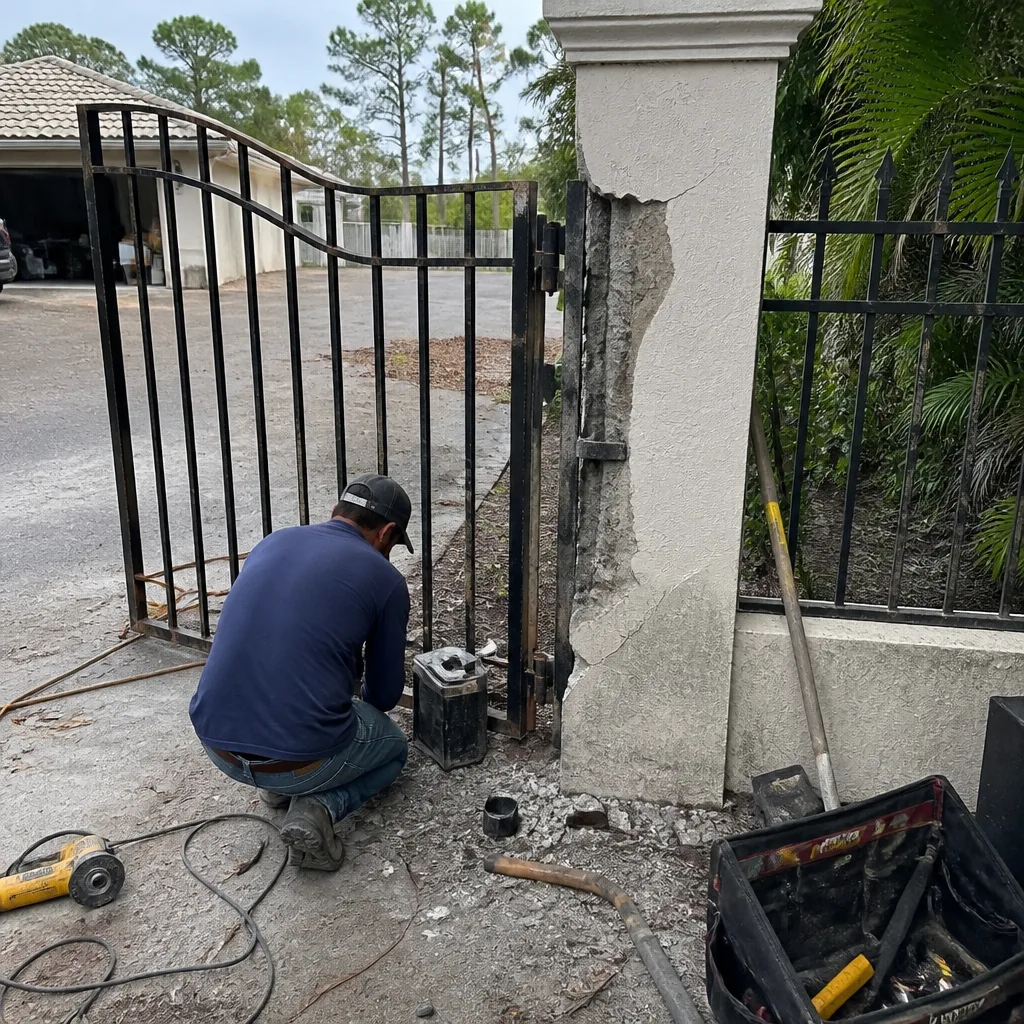 Before
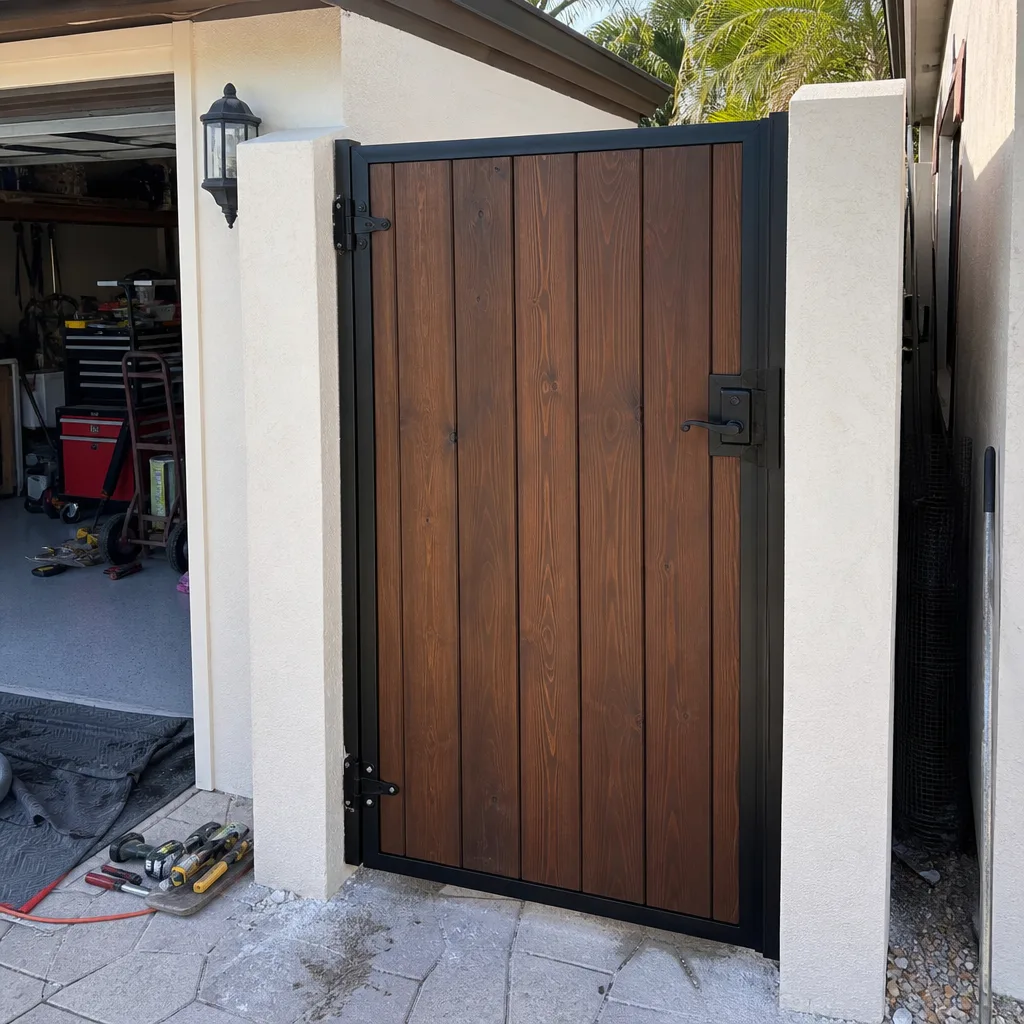 After
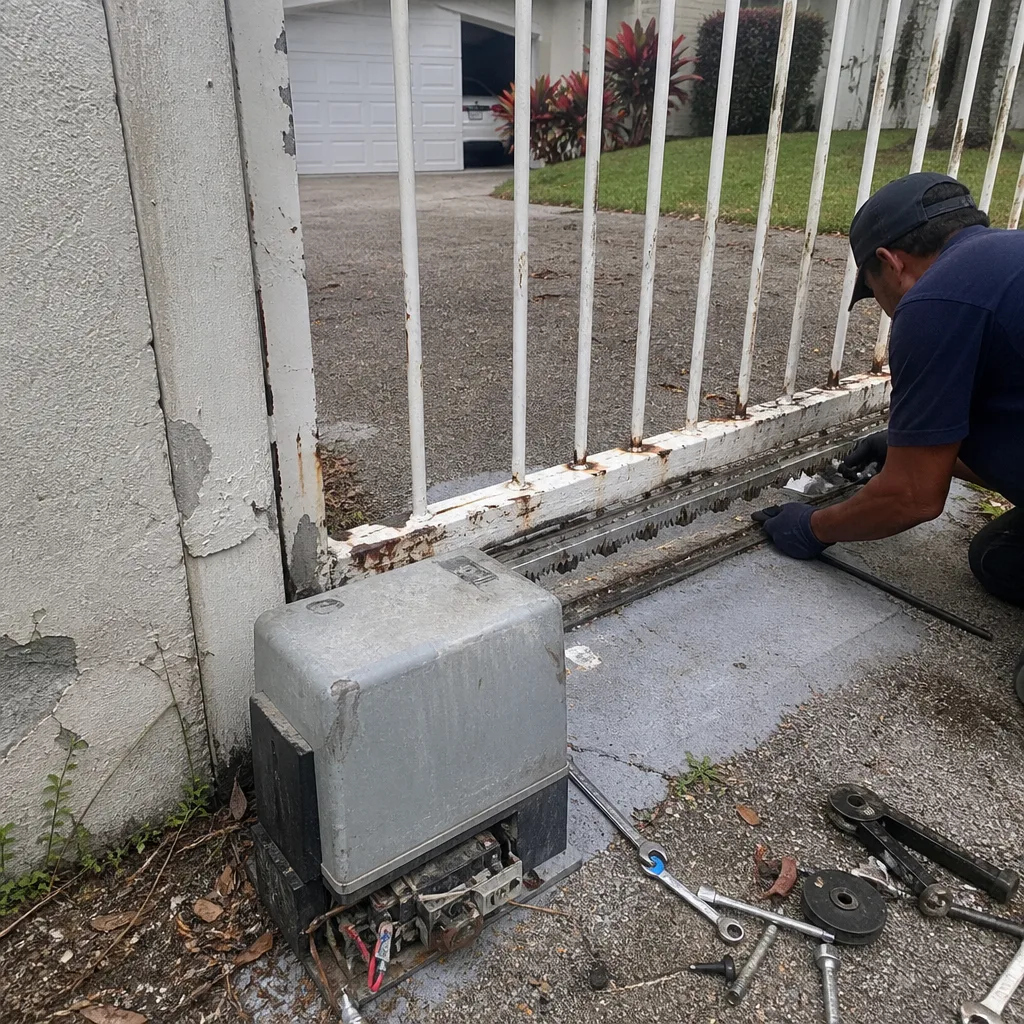 Before
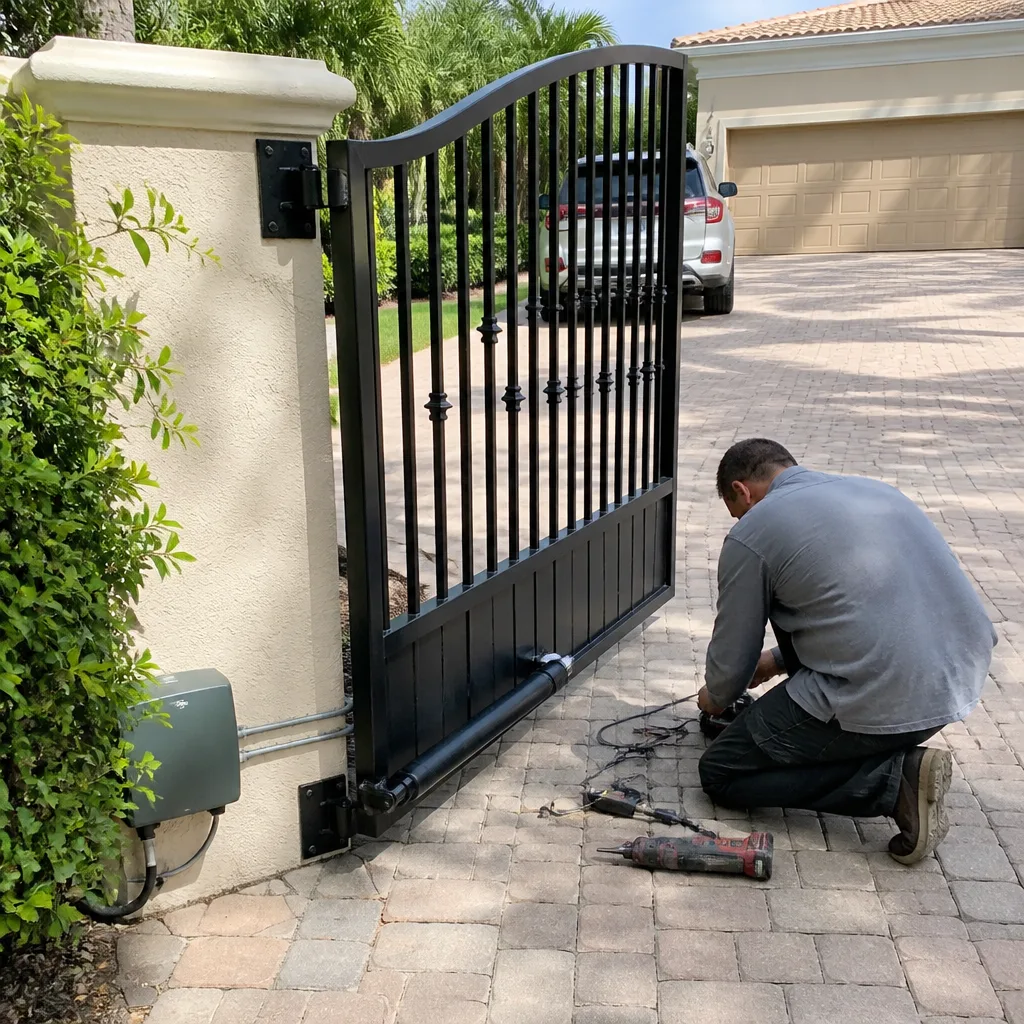 After
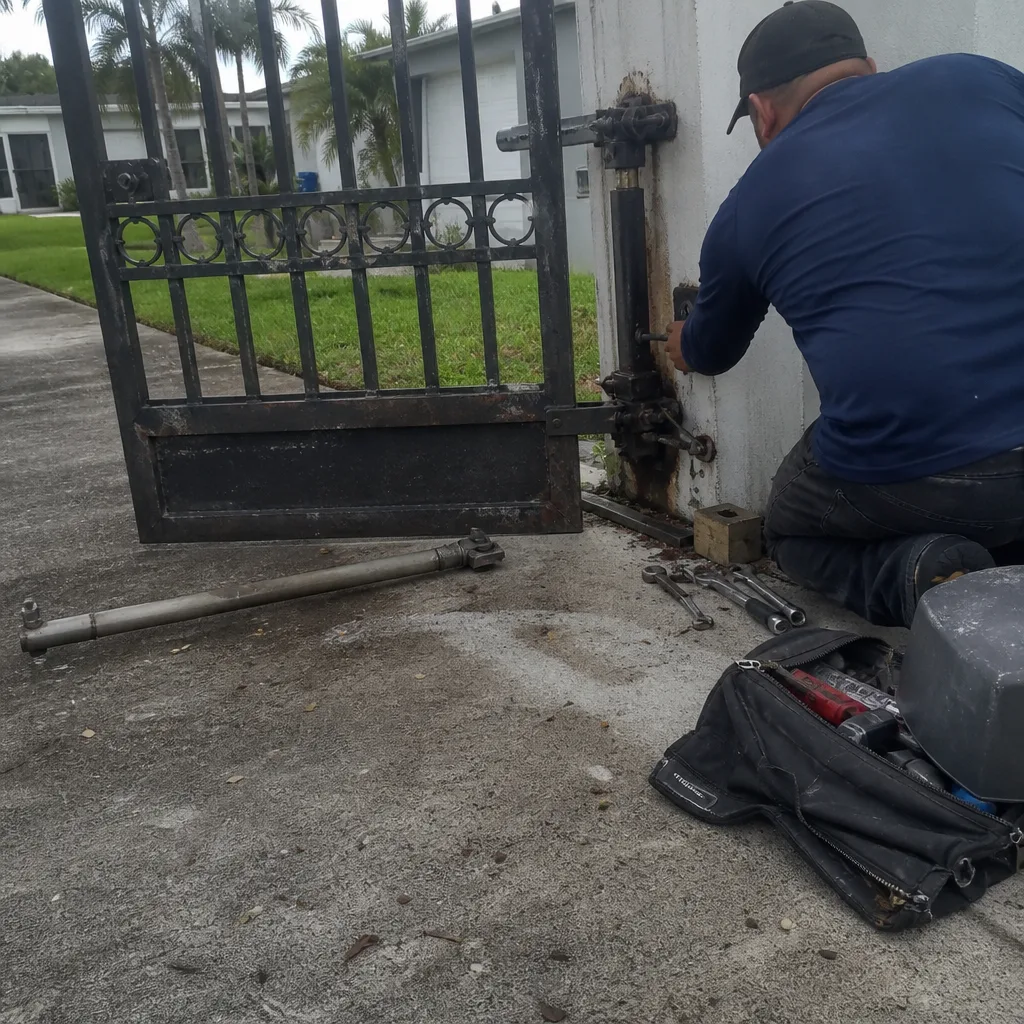 Before
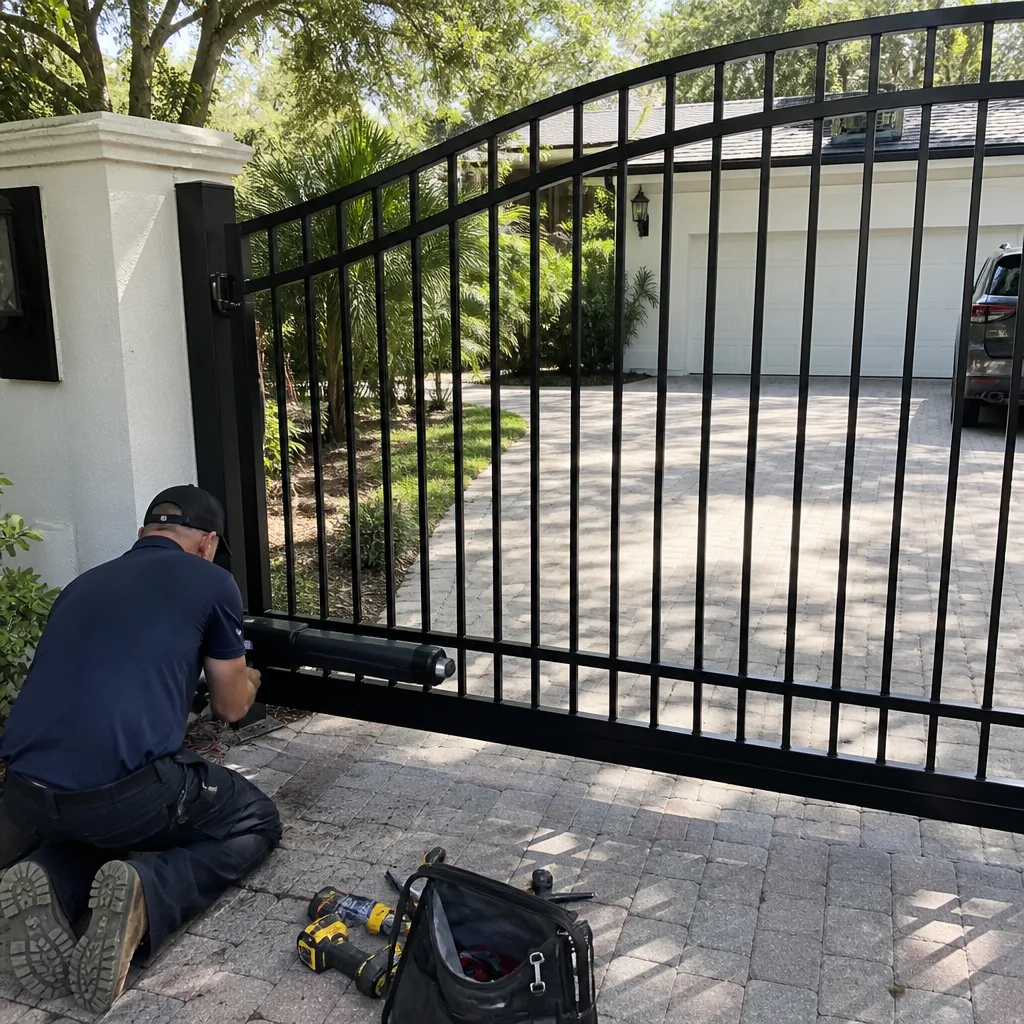 After
When to Call a Professional
Some gate issues are DIY-appropriate: lubricating hinges, tightening visible hardware, cleaning debris from the track. Most everything else is not. If your gate won’t open, opens partially, reverses unexpectedly, makes grinding or clicking sounds, or the remote and keypad stop working, call a professional before the problem compounds. Automated gates involve electrical components, high-tension mechanical parts, and safety sensors that must be calibrated correctly. A misaligned photo eye or a poorly adjusted limit switch can create real safety hazards, especially on heavy slide gates or swing arms. If your gate is failing intermittently or you’ve had the same problem repaired twice by the same company, it’s time for a different set of eyes. Courtyard Gate Repair offers free estimates in Fort Myers – call (844) 791-3898.
Frequently Asked Questions
A qualified gate repair contractor will be able to name specific operator brands they’ve serviced recently and describe common failure modes for those brands in detail. They’ll give you a structured diagnostic process, be licensed and insured in Florida, and provide written quotes with specific line items. If they can’t answer brand-specific questions with confidence, they’re likely a generalist. For Gate Repair in Fort Myers, verify demonstrated experience with your specific equipment before scheduling anything.
Gate repair costs in Fort Myers typically range from $150 for basic adjustments and sensor realignment to $400 – $900 for control board or motor replacement, depending on brand and complexity. High-cycle commercial systems like DoorKing or BFT units can run higher. The only way to get an accurate price is with a written diagnostic. Call (844) 791-3898 for a free estimate and we’ll give you a real number before any work starts.
A general handyman can sometimes handle basic mechanical issues on manual gates, but automated electric gates involve control boards, limit switches, safety sensors, and line-voltage wiring that require specialized training. An incorrect diagnosis can turn a $150 sensor replacement into a $900 board failure down the line. For Electric Gate Repair in Fort Myers, use a specialist who works on automated systems daily, not a generalist who touches gates occasionally.
If your gate fails during storm season in Fort Myers, check the breaker first, then look for visible storm damage like debris in the track or fixtures pulled loose. Don’t attempt to force the gate open or work on electrical components during wet conditions. Call a gate specialist who can diagnose storm-related failures including surge damage, water intrusion into control enclosures, and corrosion issues. Many Fort Myers gate companies, including us, prioritize storm-season service calls because a non-functioning gate can compromise property access exactly when you need it most.
You should repair your existing gate operator when the failure is isolated to a specific component like a limit switch, capacitor, receiver, or photo eye, and the operator is otherwise in good condition. Replacement makes sense when the motor windings are shorted, the control board has failed on a unit that’s 12 – 15 years old, or cumulative corrosion from Fort Myers’s salt air has compromised multiple systems. A brand-agnostic technician can tell you which situation you’re in based on a written diagnostic, not a sales script. If you’re considering Gate Installation in Fort Myers, we’ll give you an honest comparison of repair versus replacement cost before you commit either way.
Most reputable gate repair companies in Fort Myers offer free estimates for defined-scope work like new installations, where the project requirements are knowable upfront. Repairs typically require a paid diagnostic visit because the technician has to open the equipment to determine what failed. Some companies, including Courtyard Gate Repair home, apply the diagnosis fee to the repair cost if you approve the work. Always ask about this before the technician arrives so you know the all-in cost.
The Bottom Line
Hiring a gate repair contractor in Fort Myers comes down to demonstrated competency, not just credentials. A license proves legality. Insurance proves responsibility. Neither proves the person can diagnose your specific Viking board or Ghost Controls sensor. Vet by asking brand-specific questions, demand a written diagnostic before accepting any replacement recommendation, and get contract terms covering labor warranty, callbacks, and diagnosis fees in writing before work starts. The difference between a specialist and a generalist is not advertising language, it’s what happens six months after the repair. A diagnosis that finds the root cause lasts for years. A guess lasts until the next storm.
Written by the team at Courtyard Gate Repair, serving Fort Myers since 2017.