
Last updated October 30, 2026
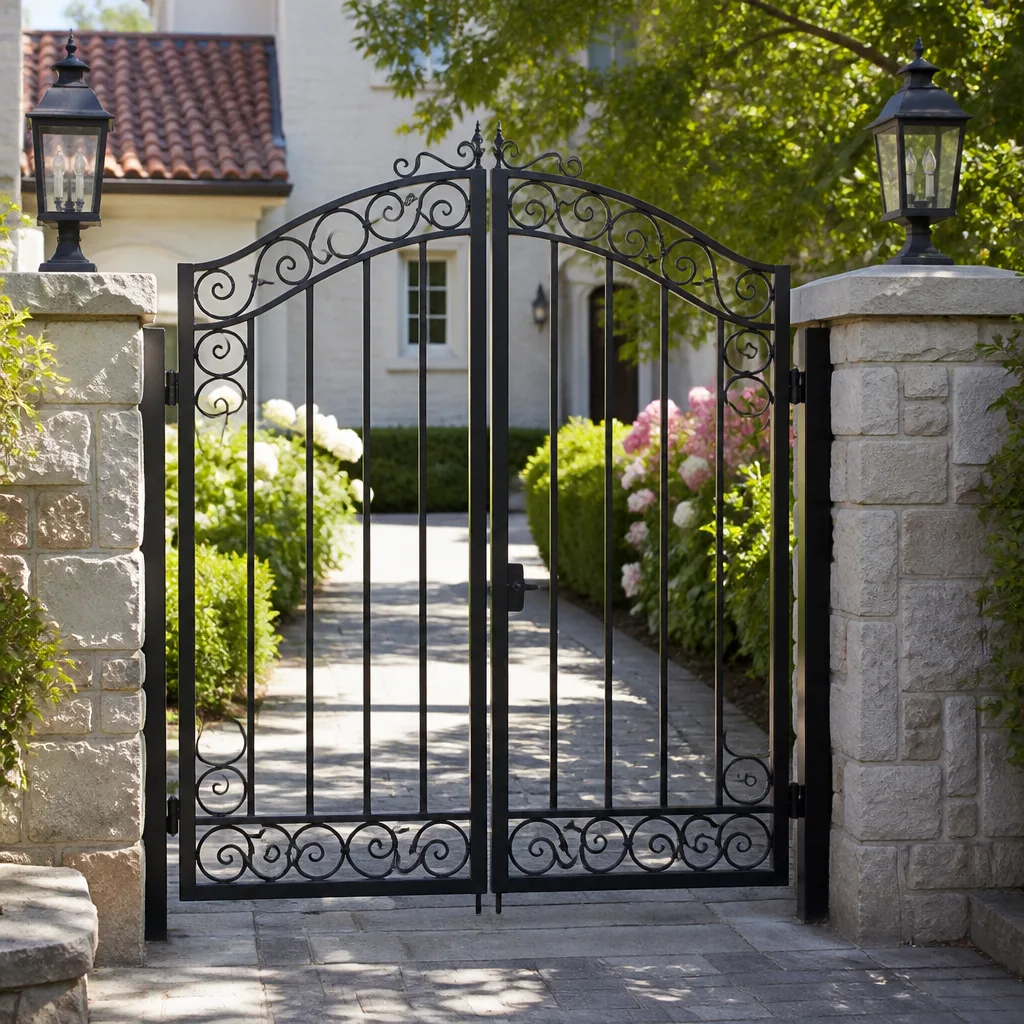 Wrought iron
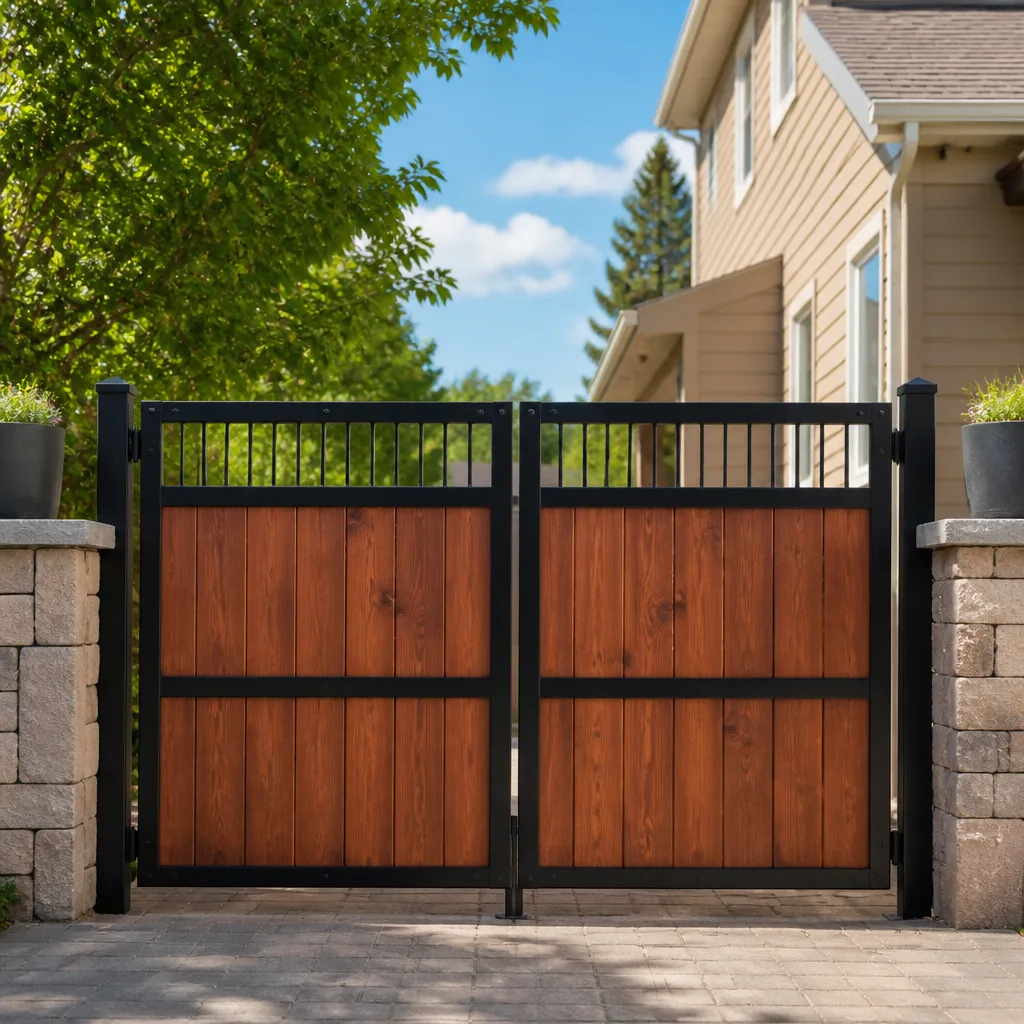 Wood & steel frame
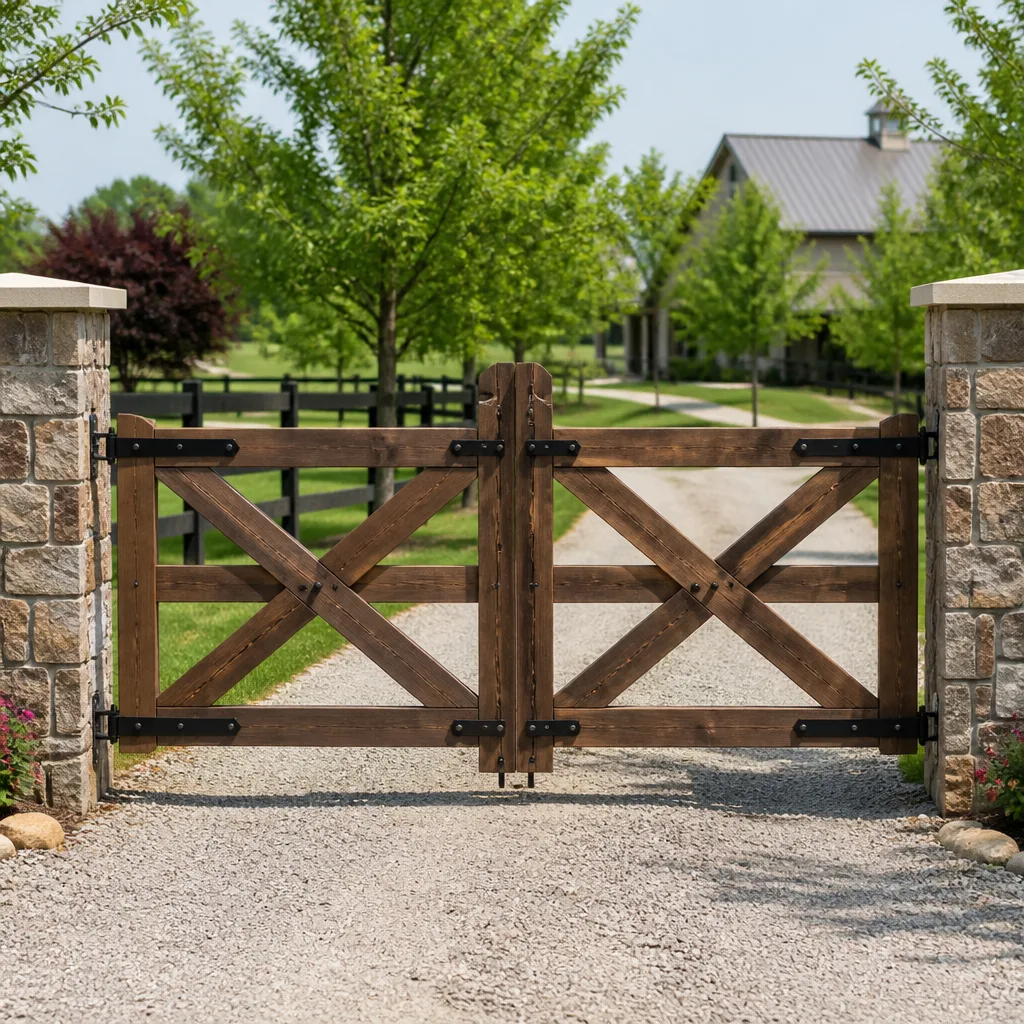 Farm & ranch
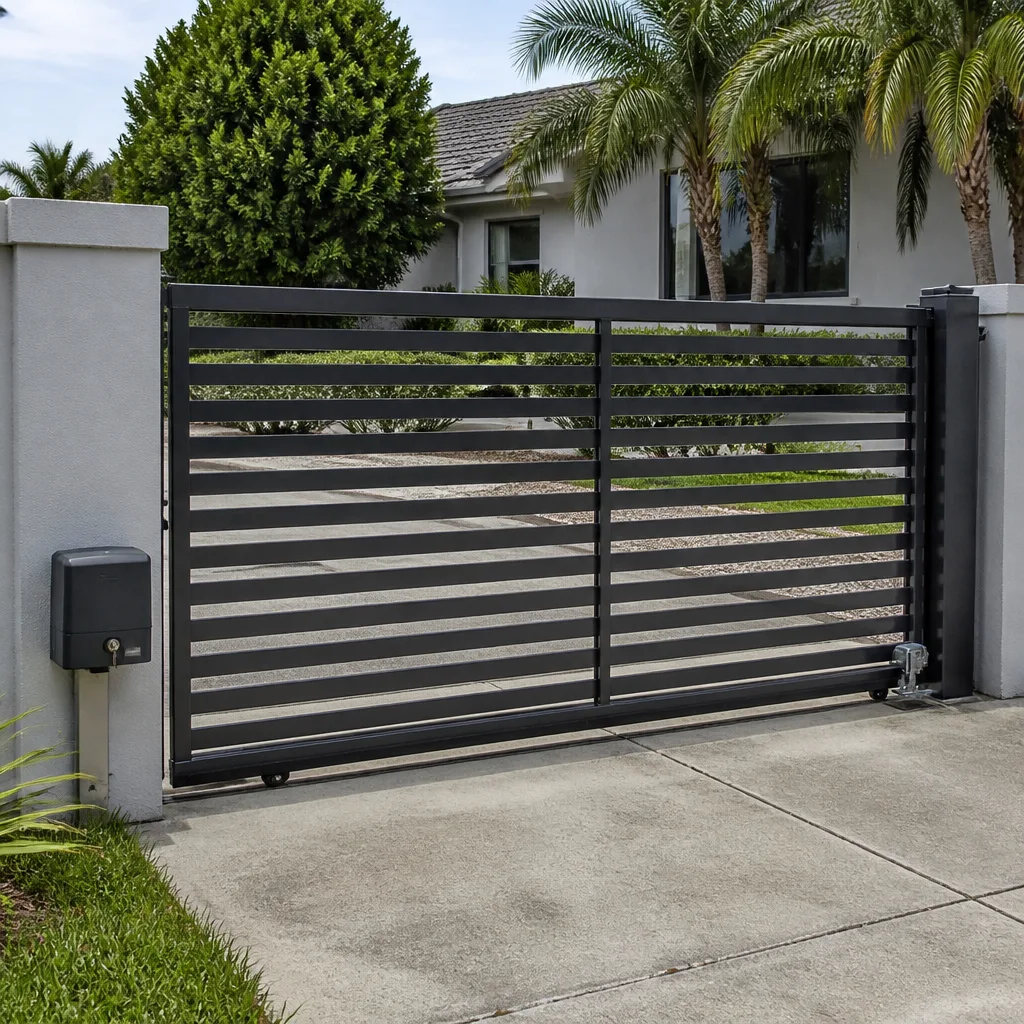 Sliding driveway gates
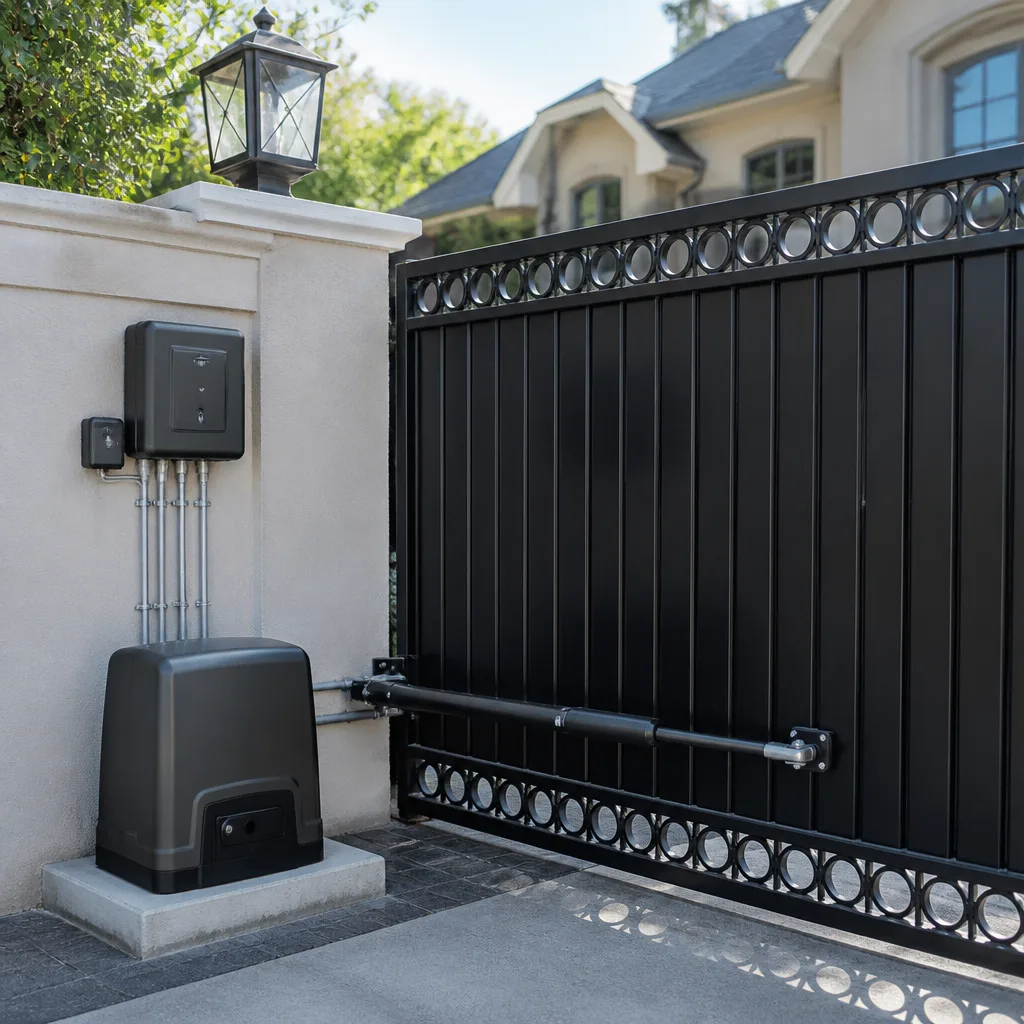 LiftMaster operators
Free on-site gate assessment - hinges, posts, and your LiftMaster or Nice gate operator checked before anything is quoted
The assessment is free and the quote is the invoice.
Get your free estimateThe Complete Gate Repair Guide for Fort Myers Homeowners
Between May and November, Fort Myers gate systems don’t just wear down. They get attacked. We’re talking about daily humidity swings that push 90%, afternoon thunderstorms that dump two inches of rain in an hour, and salt-laden air rolling in off the Gulf that settles into every hinge, weld, and circuit board on your property. The six months that locals call hurricane season are also the window when roughly seven out of ten gate operator failures occur in this part of Southwest Florida. This guide explains why Fort Myers gates break the way they do, how to spot the real cause before you pay for the wrong fix, and what actually keeps an automated gate working through our climate. For hands-on help, see our Gate Repair services. If you own a home in Fort Myers with an electric gate, this is the reference you’ll come back to every time the system acts up.
Styles & brands we work with
Quick Answer
Gate repair in Fort Myers, FL typically costs between $185 and $650 for common operator and mechanical failures, with most repairs completed same-day when parts are in stock. The most frequent local failure points are corroded hinges and weld joints from salt air, limit switches knocked out of calibration by wind gusts, and circuit boards degraded by humidity and electrical surges. A brand-agnostic gate specialist who knows LiftMaster, DoorKing, Elite, Mighty Mule, and FAAC systems can diagnose the true failure in under an hour and quote the exact repair before any work begins. For deeper reading, check out The Complete Guide to Gate Repair in Fort Myers.
Table of Contents
- How Fort Myers Climate Breaks Gate Systems Differently
- Salt Air Corrosion: The Three-Year Clock on Metal and Boards
- Hurricane Code and Your Gate: What Non-Compliant Repairs Cost You
- Operator Problem, Structural Problem, or Foundation Problem: How to Tell
- Why Brand-Agnostic Diagnosis Matters for Mixed-System Gates
- A Seasonal Maintenance Calendar Built for Fort Myers Weather
- What Gate Repair Actually Costs in Fort Myers
- Common Mistakes to Avoid
- When to Call a Professional
- Frequently Asked Questions
- The Bottom Line
How Fort Myers Climate Breaks Gate Systems Differently
A gate that lasts fifteen years in Phoenix can be on its third repair cycle by year five in Fort Myers. That’s not an exaggeration. Our climate combines three factors that each strain gate components in their own way, and together they create failure patterns you won’t see in drier, cooler, or more stable weather environments.
First, the humidity. Fort Myers averages 74% relative humidity year-round, with summer afternoons regularly crossing 85%. That moisture works its way into operator housings through ventilation gaps and settles on circuit boards. Over time, the moisture combines with microscopic salt particles to create a conductive film across board traces and solder joints. The result is erratic behavior: a gate that opens fine in the morning but refuses to respond at 4 p.m.; sensors that false-trigger and reverse the gate for no visible reason; keypads that need three or four presses before the board registers input.
Second, the afternoon storm cycle. Southwest Florida gets 54 inches of rain annually, concentrated in drenching downpours that move through fast and leave standing water behind. Operators mounted at ground level or in low spots get splash exposure. Underground conduit joints settle and crack, letting water into the low-voltage wiring that runs from the keypad to the board. When that happens, the system sees phantom signals from shorted wires and can behave erratically or lock itself out.
Third, the wind. Sustained tropical-storm-force winds and the frequent gust fronts from afternoon thunderstorms push against your gate leaf every time one blows through. For a cantilevered slide gate or a swing gate with solid infill panels, that’s a lot of lateral force hitting the rollers, hinges, and operator arm. Over enough storm cycles, a gate that started square and plumb drifts out of alignment. The operator then has to work harder to move the same gate, which accelerates motor wear and shortens the life of the drive belt or chain.
This is why we approach Gate Repair in Fort Myers differently than we would in another market. The first question isn’t just “What broke?” It’s “What did our climate do to it, and what do we need to address so this doesn’t happen again in eight months?”
Salt Air Corrosion: The Three-Year Clock on Metal and Boards
We regularly see gate hinges in Fort Myers communities like McGregor, Whiskey Creek, and anywhere within two miles of the Caloosahatchee that look decades old when they’re actually four or five years from the install date. Salt exposure accelerates galvanic corrosion anywhere two unlike metals touch, and anywhere protective coatings have been scratched during installation.
The corrosion pattern follows a predictable sequence:
- Year one: The powder coat or galvanizing looks intact, but salt film is building inside the hinge barrels and on the operator’s internal mounting hardware. No visible symptoms yet.
- Year two: Rust begins forming at weld points, hinge pins, and bolt heads. The gate starts to feel heavier when moved manually. The operator runs slightly hotter as it works against increased friction.
- Year three: The visible rust spreads. Hinge pins seize or develop play. Weld joints show flaking. The operator’s limit switch now reads incorrectly because it’s measuring against drifted gate travel. This is when most owners call us.
Material choice determines how fast this clock runs. Powder-coated aluminum holds up the longest in Fort Myers; marine-grade stainless hardware is the only stainless we recommend within a mile of salt water. Plain steel gates, even when powder coated, begin showing rust at weld points within two years if they’re close to the Gulf. Chain-link with galvanized fittings performs adequately but looks tired quickly. The real damage, though, is often inside the operator housing.
Circuit boards in coastal Fort Myers fail from corrosion even when the housing stays dry. The salt film creeping in through ventilation slits is enough. Boards develop green-white deposits across connectors. Capacitors swell from heat and humidity cycles. We’ve replaced Viking and Elite boards that looked like they’d been left outside in the weather, sitting inside housings that appeared sealed and dry. This is where brand-agnostic parts knowledge pays off: we can source a direct replacement board for whatever operator you have, rather than telling you the whole operator needs to go because a board corroded.
Hurricane Code and Your Gate: What Non-Compliant Repairs Cost You
Lee County and the City of Fort Myers enforce Florida Building Code requirements for gates and fencing in windborne debris regions. Your gate is part of your property’s structural envelope in the eyes of your insurer. That means the repair decisions you make now can affect a future windstorm claim.
For automated gates specifically, Florida code and common HOA standards in Fort Myers communities address three things:
- Wind load rating: Gate panels and their supporting posts must be engineered for the wind speed zone. Fort Myers sits in a high-velocity hurricane zone, so a gate installed without proper post footings or with undersized posts may fail during a named storm.
- UL 325 compliance: Automated gates must have functioning entrapment protection: reversing edges or photo eyes that stop and reverse the gate when something is in its path. A non-compliant gate is both a code violation and a serious safety liability.
- Storm preparation provisions: Many Fort Myers HOAs require that automated gates have a manual release or can be permanently opened before an evacuation. If your gate can’t be secured open without power, that’s a real problem when a storm is 48 hours out.
Here’s what many homeowners don’t realize: if a repair shop replaces your gate opener without reinstalling or recalibrating the safety edges and photo eyes, your gate may no longer meet UL 325. If that gate then injures someone or fails during a storm, your insurance claim can be complicated by the non-compliant repair. It matters who touches your system. A repair technician who works on gates every day knows which safety devices belong on a Fort Myers automated gate and tests them after every board or motor replacement.
We’ve also seen the post-hurricane inspection reality: after a storm, adjusters look at gates that failed and ask whether the gate was maintained and compliant before the event. Documented maintenance and code-compliant repairs help that conversation. Handshake repairs from a generalist don’t.
Operator Problem, Structural Problem, or Foundation Problem: How to Tell
The most expensive mistake in gate repair is fixing the wrong category of problem. A gate that won’t open smoothly could have a dying motor. It could also have a settling post, a seized hinge, or a wheel that’s been grinding pavement for six months. If you replace the operator and the structural issue remains, you’ll be replacing the operator again in a year or two. We see it constantly.
Here’s how to separate the three categories:
Operator problems: the electronics and drive train
When the operator is the failure point, the symptom is usually electrical. The gate buzzes but doesn’t move. The gate moves two feet and stops. The remote works intermittently. The keypad doesn’t respond. In these cases the mechanical structure of the gate is usually fine: the hinges move freely, the gate swings without drama when released, and the posts feel solid. The problem is the board, the capacitor, the motor brushes, the limit switches, or the gearbox.
Structural problems: the gate leaf itself
When the gate itself is the problem, the symptom is often mechanical resistance or visible sag. The gate scrapes the ground. A swing gate droops so the latch no longer lines up. A slide gate waddles side to side as it tracks. You may hear grinding or squealing from the rollers or hinges, and the operator often trips its overload protection trying to move a gate that’s fighting back. In Fort Myers, this category is dominated by corrosion at the hinge barrels and weld cracking from wind fatigue.
Foundation and post problems: what the gate hangs on
When the posts or the track foundation are the problem, you’ll notice the gate’s arc or path changing over time. A swing gate that once cleared the driveway apron by four inches now clears it by one. A slide gate with a concrete track bed shows cracking or upheaval at the joints. Post movement comes from undersized footings, erosion from our heavy rains, or repeated lateral impacts from wind gusts.
The fastest way to narrow the field: release the operator and move the gate by hand. If it moves smoothly through its full travel, the structure and foundation are probably okay and the problem is in the operator. If it’s hard to move, bound up, scrapes, or wobbles, the mechanical issue comes first. This test alone saves homeowners from thousands of dollars in mistaken replacements.
Why Brand-Agnostic Diagnosis Matters for Mixed-System Gates
Here’s a scenario we see in Fort Myers neighborhoods every month: a homeowner has a LiftMaster operator mounted on an Elite gate frame, wired to a Viking control board because a previous repair swapped the board three years ago. The gate stops working intermittently. The homeowner calls a company that installs LiftMaster systems. Their diagnosis: replace the LiftMaster operator. The homeowner does that. The problem returns a week later because the fault was actually in the Viking board’s limit input circuit, which was dropping signal due to corrosion.
This is the hidden cost of single-brand expertise. Most gate failures in Fort Myers don’t happen inside one component. They happen at the interaction points: the board-to-motor wiring, the limit switch mounting, the photo eye alignment, the keypad-to-board communication. When those interaction points fail, a technician needs to understand each component’s signaling and voltage behavior to trace the fault. Knowing one brand deeply is not enough.
Courtyard Gate Repair works this way because it’s the only way that works. We maintain diagnostic references and parts sourcing for LiftMaster, FAAC, BFT, Linear, Viking, Ghost Controls, DoorKing, Elite, and Mighty Mule operators. That means when your Elk- or DoorKing-based system misbehaves, we trace the fault through the actual wiring and control logic of your existing setup, not through a sales pitch for whatever brand we happen to carry. We repair what others replace because we’ve diagnosed what’s actually broken.
Your brand. Our expertise.
If you’re in the early stages of planning a new gate rather than repairing an existing one, you can read more about Gate Installation in Fort Myers to understand what a properly engineered Fort Myers install looks like from the start.
A Seasonal Maintenance Calendar Built for Fort Myers Weather
Manufacturer maintenance schedules are written for an average climate. Fort Myers doesn’t have an average climate. Here’s the maintenance rhythm that actually fits Southwest Florida, based on what we’ve seen fail and when:
April: Pre-Hurricane Season Inspection
- Test the manual release mechanism. If you can’t pull it in ten seconds, that’s a problem you do not want to discover in June.
- Inspect every hinge, bolt, and weld for rust bloom. Treat or replace now, before summer humidity accelerates it.
- Run the gate through five full open/close cycles and listen. New noises mean new wear.
- Check the photo eyes and safety edges. Confirm the gate reverses under resistance.
- Verify the operator’s gearbox or drive chain is lubricated per the manufacturer’s spec.
May through October: Monthly Visual Checks
- Look for standing water around the operator base and the slide gate track after storms.
- Watch for sand and debris building up in the track channel.
- Test the gate on a humid afternoon: if response is sluggish in high humidity, the board may be developing corrosion problems.
- After any wind event above 40 mph, check that the gate’s closed position still fully latches and the open position still clears the sensor path.
November: Post-Season Repair Window
November through March is when Fort Myers gate repair work gets done that requires parts ordering, concrete work, or full removal of the gate leaf. The dry season lets us disassemble a gate without fighting afternoon rain, and owners aren’t worried about a storm while the gate is out of service. This is the right time for hinge replacement, weld repair, post remediation, or board swaps.
January: Lubrication and Tightening Pass
The cool dry weather is ideal for a full lubrication pass on hinge pins, rollers, chains, and screw drives. It’s also the right time to re-torque every fastener and inspect the operator’s mounting plate for concrete anchor movement.
This is the maintenance rhythm that works for Fort Myers specifically, not a generic calendar someone in Atlanta would follow. And if the idea of doing any of this yourself doesn’t appeal, that’s what we’re for. For a more focused look at automated systems specifically, see our guide to Electric Gate Repair in Fort Myers.
What Gate Repair Actually Costs in Fort Myers
Gate repair pricing in Fort Myers varies by the part, the brand, and the labor involved. Here are realistic ranges based on what we quote and complete in this market:
| Repair Type | Typical Fort Myers Cost Range | Notes |
|---|---|---|
| Diagnostic service call | $85 – $150 | Often credited toward the repair if you proceed. |
| Limit switch replacement | $180 – $320 | Most common wind-related failure. Includes calibration. |
| Photo eye or safety edge replacement | $150 – $350 | UL 325 compliance required; includes reversal testing. |
| Circuit board replacement | $275 – $650 | Brand-dependent. LiftMaster boards run lower; FAAC and BFT boards run higher. |
| Hinge replacement (pair) | $300 – $600 | Marine-grade hardware recommended near salt water. |
| Weld repair | $150 – $400 | Cost depends on accessibility and number of joints. |
| Full operator replacement | $900 – $1,800 | Includes new board, motor, and full safety retest. |
| Post re-setting or replacement | $500 – $1,400 | Most expensive structural repair; often tied to foundation work. |
These are honest Fort Myers market ranges. What we quote you before any work starts is the price you pay unless something genuinely changes during the repair and you approve it first. That’s a guarantee, not a sales line. You should never accept a gate repair quote that doesn’t put the number in writing before work begins, and you should never pay a deposit before the technician has diagnosed the issue and shown you what they’re doing. For related guidance, see DIY vs Professional Gate Repair: The Fort Myers Homeowner’s Decision Guide.
Common Mistakes to Avoid
- Replacing the operator before checking the mechanical load. A seized hinge or a dragging wheel will kill a new operator the same way it killed the old one. Diagnose first, replace second. We see this sequence at least once a month in Fort Myers.
- Using non-marine hardware near the water. Standard zinc-plated hinges within two miles of the Gulf start corroding in under two years. Marine-grade stainless costs more upfront and lasts far longer.
- Ignoring UL 325 safety compliance. Disabling or bypassing photo eyes and reversing edges to “get the gate working again” creates a serious safety hazard and violates code. Fix the sensors, don’t bypass them.
- Not testing the manual release before hurricane season. April is the time to discover your release is seized, not September when the evacuation order is issued. Test it, fix it, then forget about it for the next five months.
- Letting corrosion progress on weld points. Small rust at a weld joint is a cosmetic problem. Flaking rust with cracks is a structural failure in progress. The repair cost curve gets steep fast once a weld lets go under load.
- Hiring a general handyman for an automated gate. Electric gate systems involve low-voltage wiring, board-level diagnosis, and UL safety standards. A generalist with a multimeter and a good attitude is not the same as a gate specialist who sees your brand every week.
When to Call a Professional
Some gate issues are worth attempting yourself: a loose bolt, a squeaky hinge, a keypad with dead batteries. But you should call a gate professional when the gate trips its overload protection repeatedly, when circuit-board corrosion is visible, when an operator has been struck by lightning or taken a nearby surge, when the gate has drifted out of square or its posts have moved, or when safety devices are not functioning. Attempting board-level or spring-tension work without training risks injury and equipment damage, and it usually costs more to undo a homeowner’s partial fix than to have done it right the first time. Courtyard Gate Repair offers free estimates in Fort Myers, so call (844) 791-3898 and we’ll diagnose the issue, show you what we found, and quote the repair before anything gets opened up. Browse more guides & resources on our blog.
Frequently Asked Questions
Most Fort Myers gate repairs cost between $185 and $650 for common issues like limit switches, photo eyes, and board replacements. Simple fixes like a tightened chain or a recalibrated limit switch can run under $200; full operator replacements run $900 to $1,800. Call (844) 791-3898 for an exact quote, because estimates are free and the number you’re quoted before work begins is what you pay.
Yes. We identify the operator and components during the diagnostic visit, and we service LiftMaster, FAAC, BFT, Linear, Viking, Ghost Controls, DoorKing, Elite, and Mighty Mule equipment. Brand-agnostic diagnosis means we trace the actual failure in your system rather than pushing a replacement from a single manufacturer.
We schedule diagnostics as quickly as our current schedule allows, and many repair calls are completed the same day once the failure is identified and the part is in our stock or locally available. If the part has to be ordered, we’ll tell you the lead time before we start so there are no surprises.
Yes, salt-air corrosion is a major part of what we deal with in Fort Myers, particularly in communities along McGregor Boulevard, Whiskey Creek, and the riverfront areas. We recommend marine-grade hardware near salt water and can retrofit existing gates with corrosion-resistant hinges and fasteners.
No. A failed circuit board does not mean you need a new operator, and we stock or can source direct replacement boards for most major brands, including LiftMaster and DoorKing. We repair what others replace, because the right board fixes the system for a fraction of the cost of a new operator.
Yes. Lee County enforces Florida Building Code wind-load requirements, and automated gates must meet UL 325 entrapment safety standards. Non-compliant gates create liability and can complicate an insurance claim after a storm. We test safety devices after every repair and advise on storm-hardening.
The Bottom Line
Fort Myers gate systems don’t fail randomly. They fail from salt, humidity, wind, and storm cycles. The failures are predictable once you know what to look for, and most of them are repairable before they snowball into full replacements. Start with the manual diagnostic: release the operator and move the gate by hand. Watch for corrosion at the hinges and weld points before the rainy season. Test your safety devices quarterly and your manual release before every hurricane season. And when a repair is needed, use a gate specialist who understands your specific brand mix and won’t upsell you into equipment you don’t need. If you’re dealing with a gate that’s acting up, call (844) 791-3898 or visit our Courtyard Gate Repair home page to learn how we can help.
Written by the team at Courtyard Gate Repair, serving Fort Myers since 2017.
See the difference
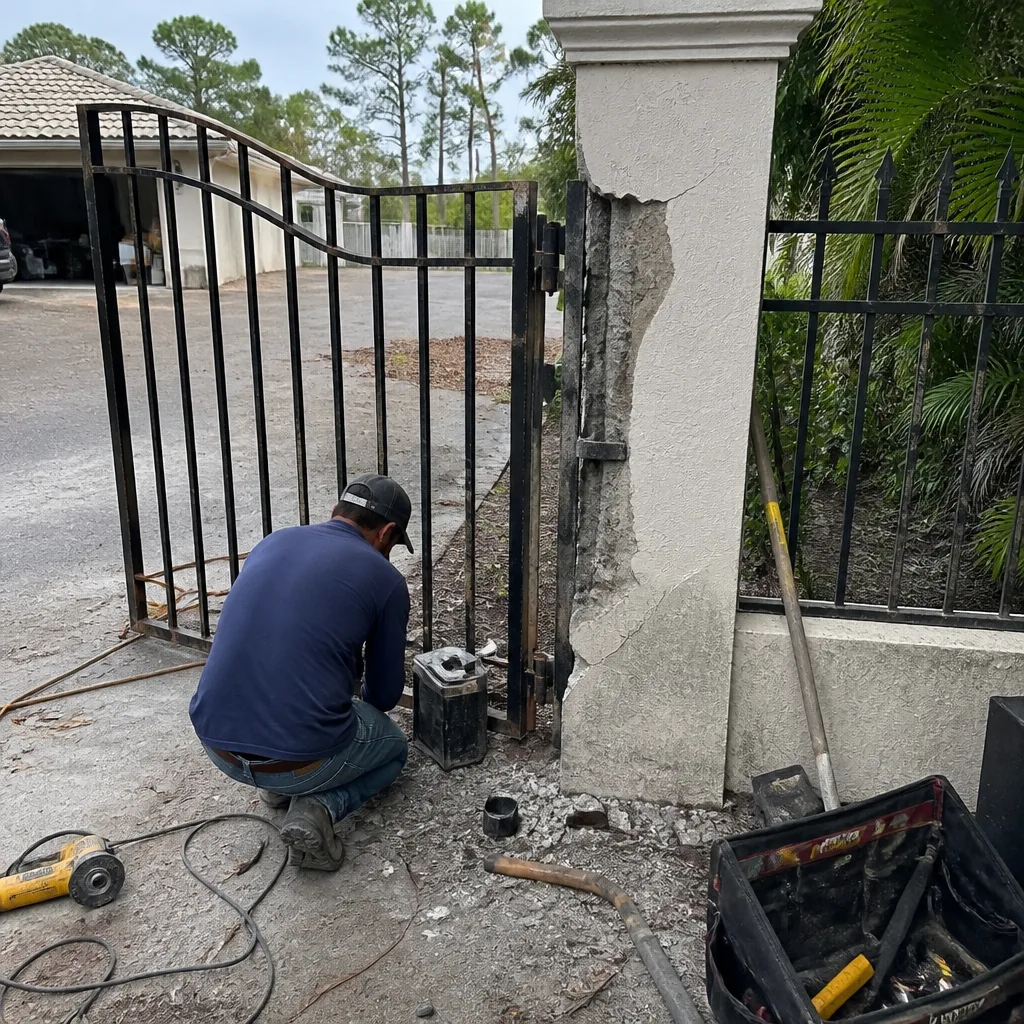 Before
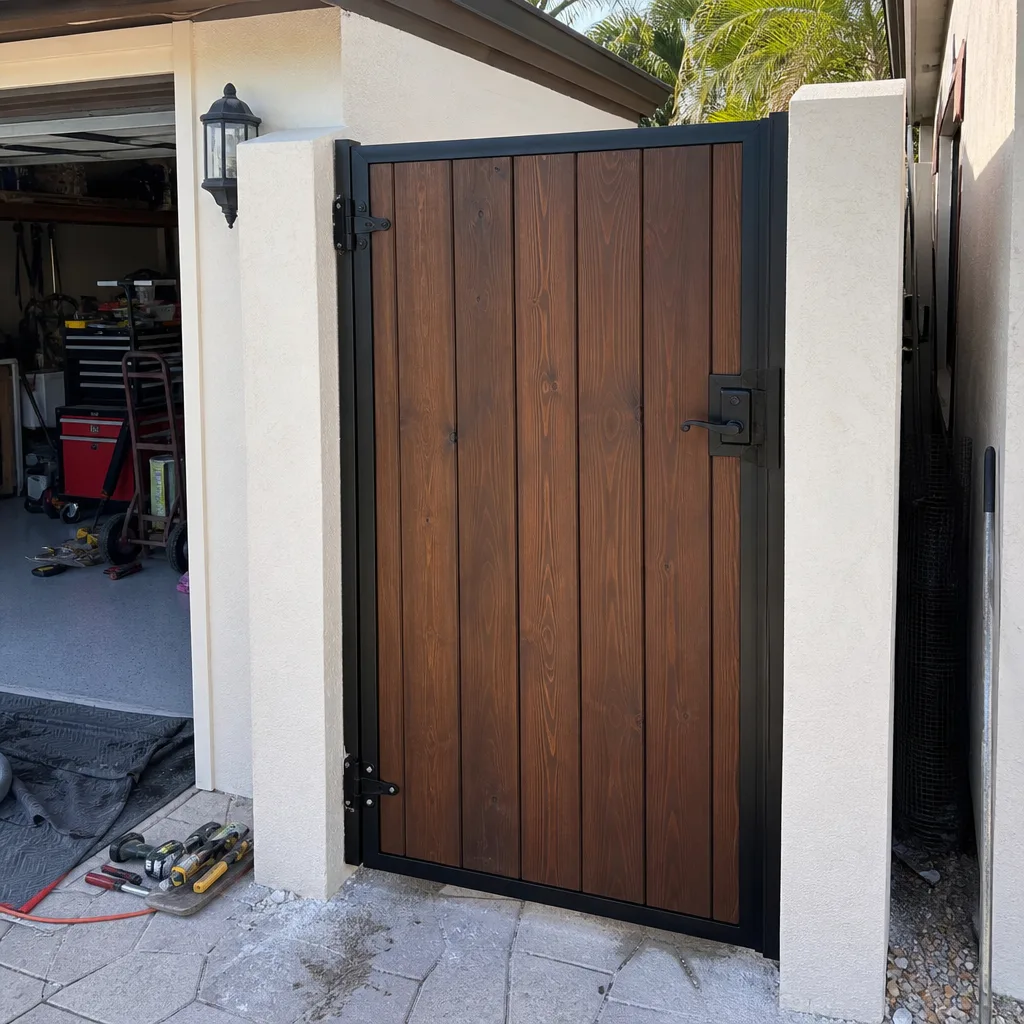 After
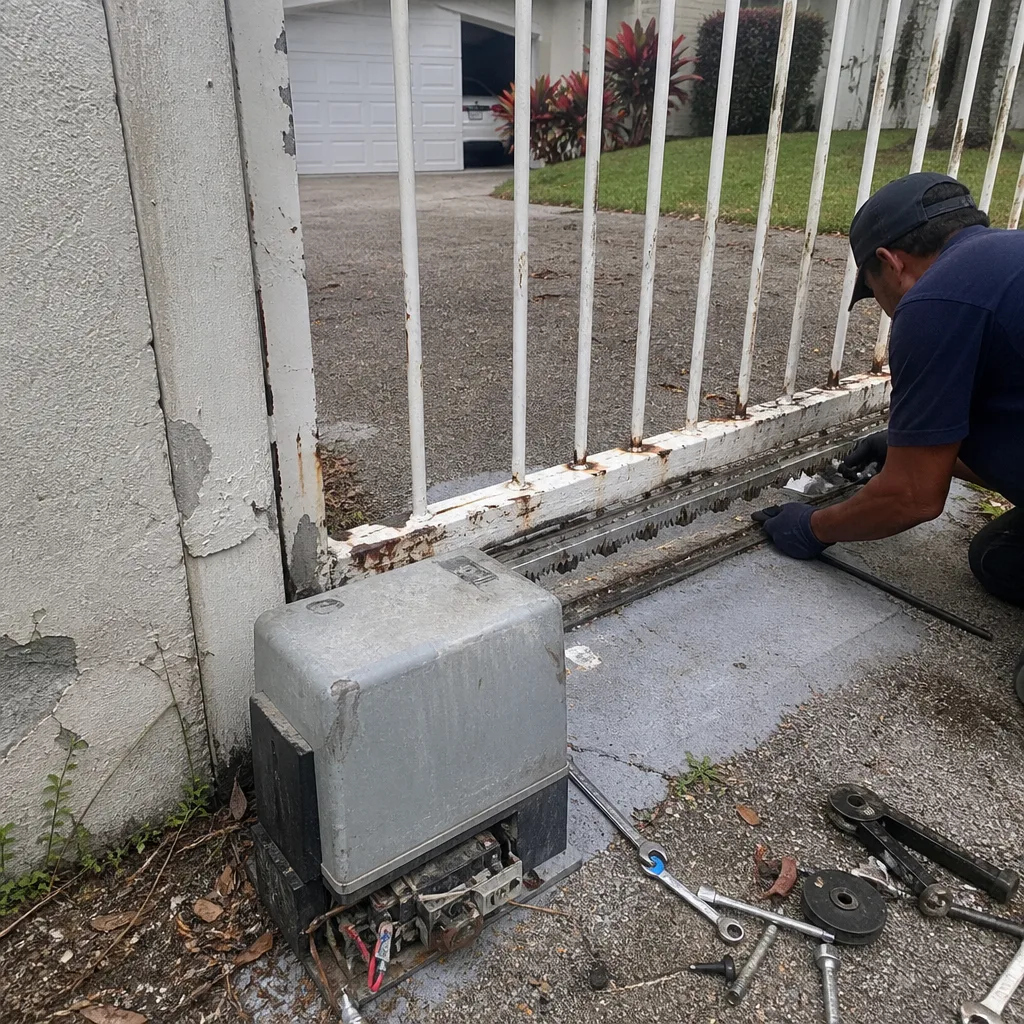 Before
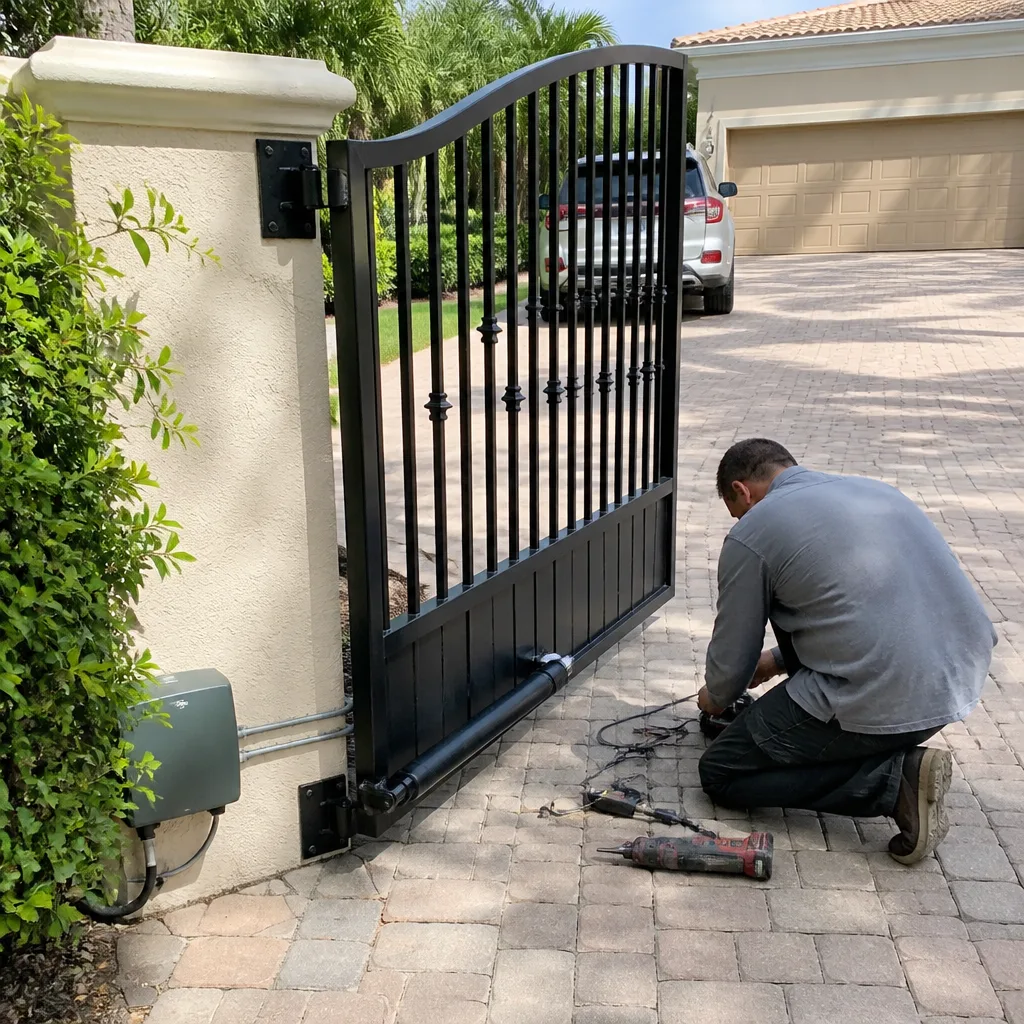 After
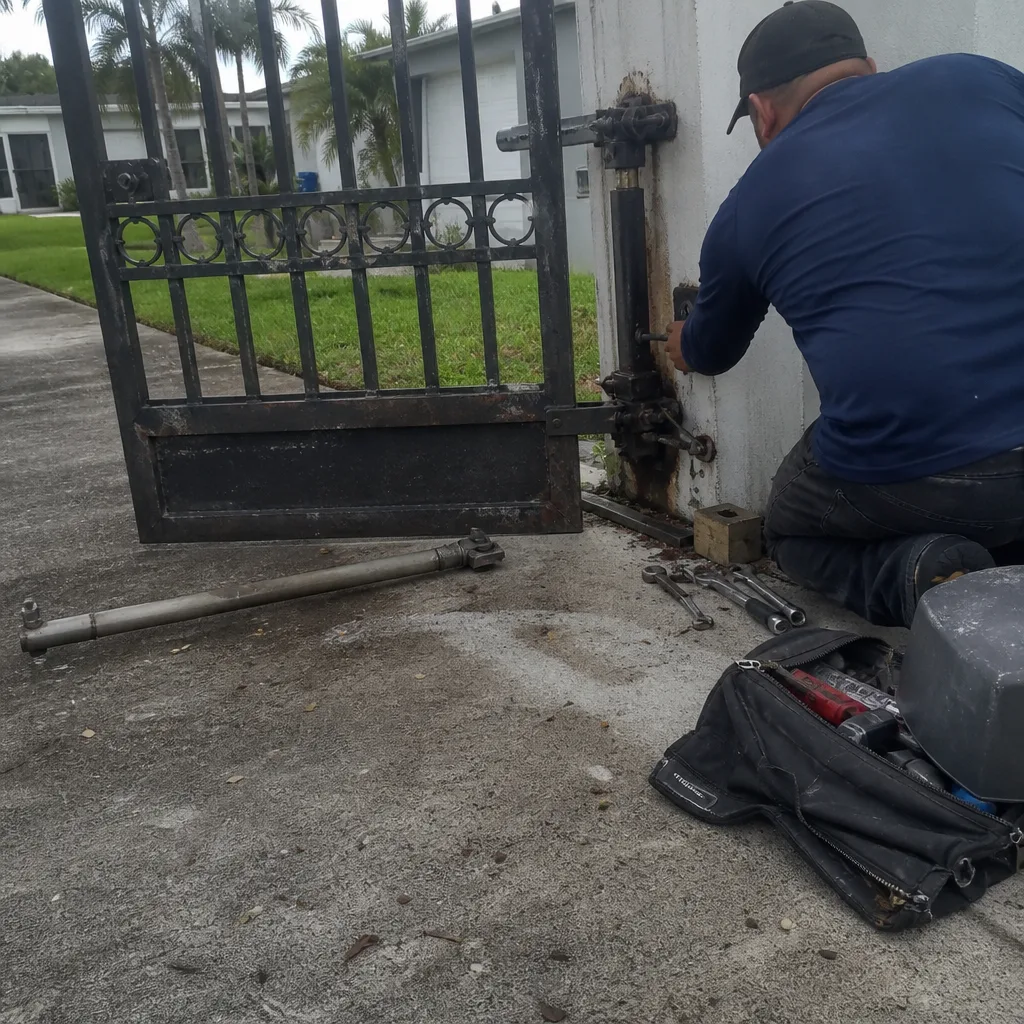 Before
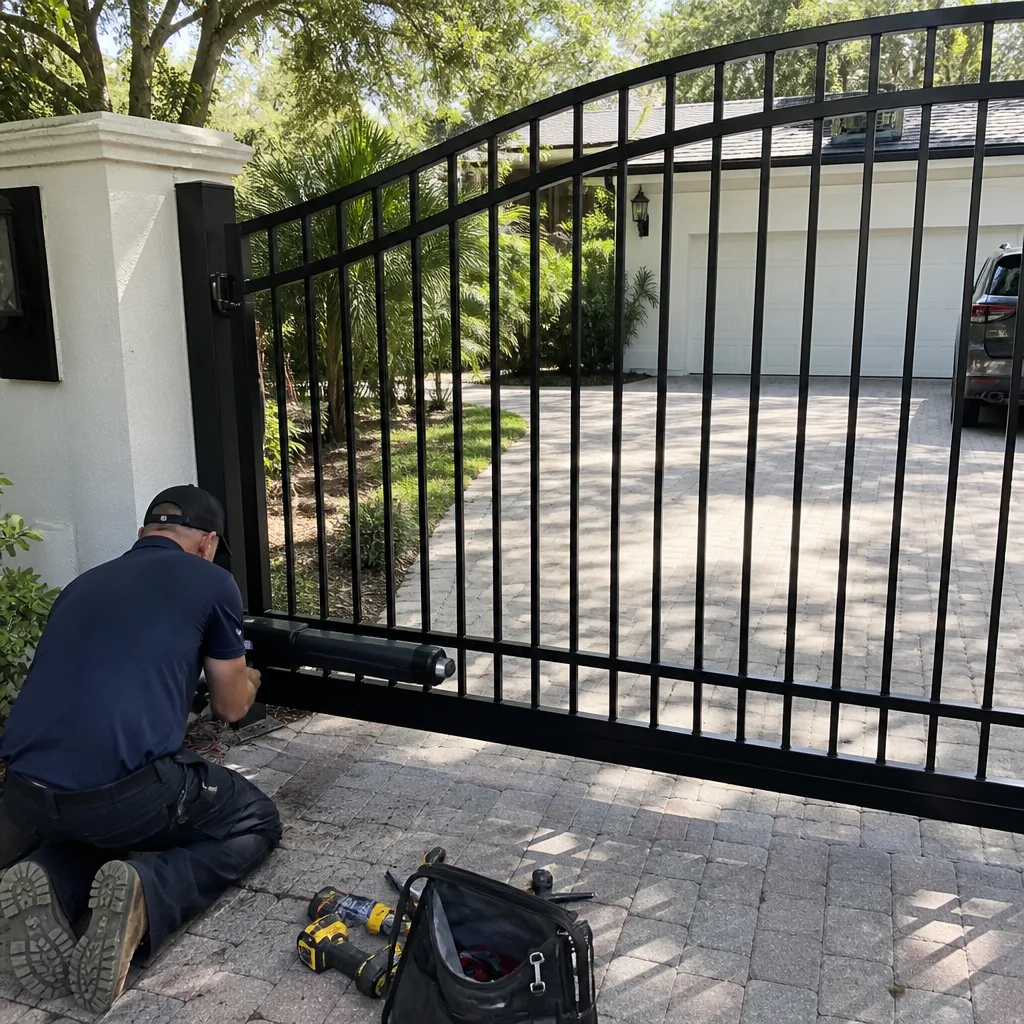 After