
Last updated October 30, 2026
 Wrought iron
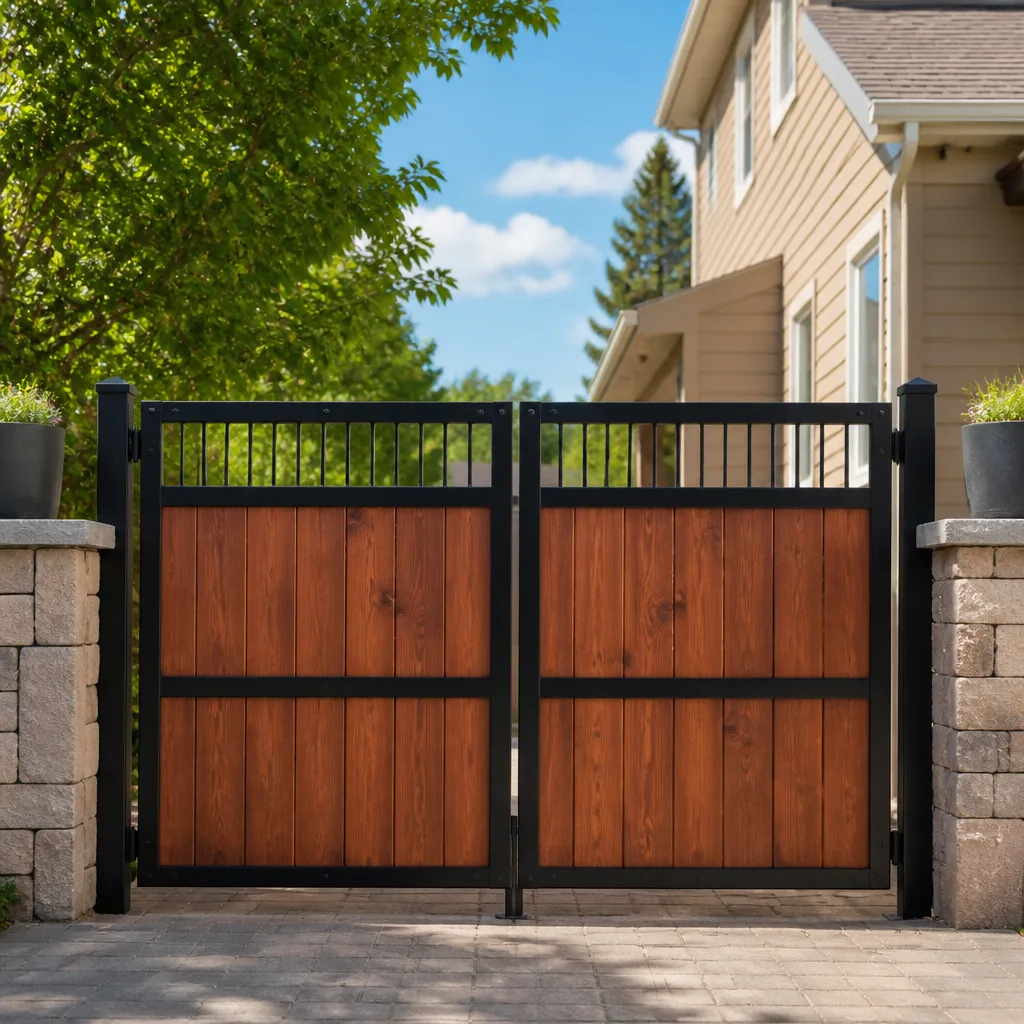 Wood & steel frame
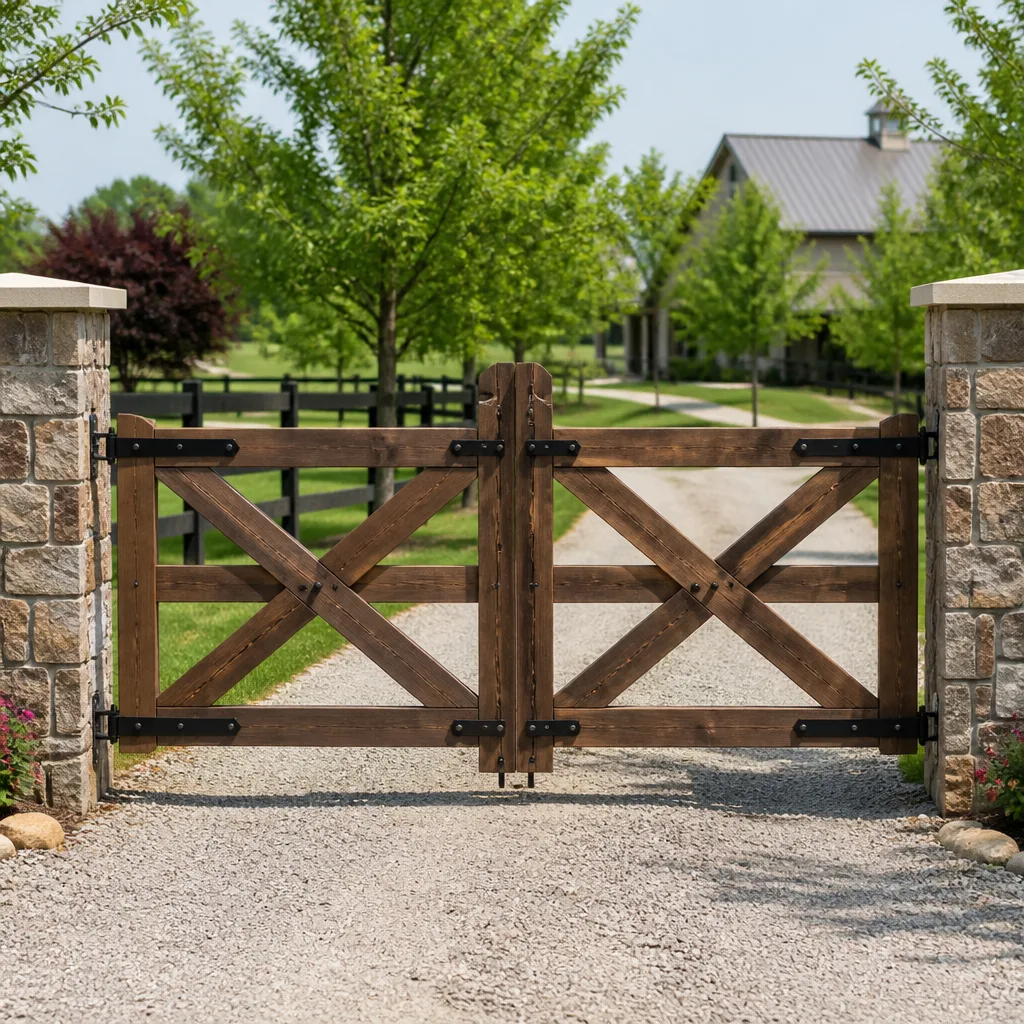 Farm & ranch
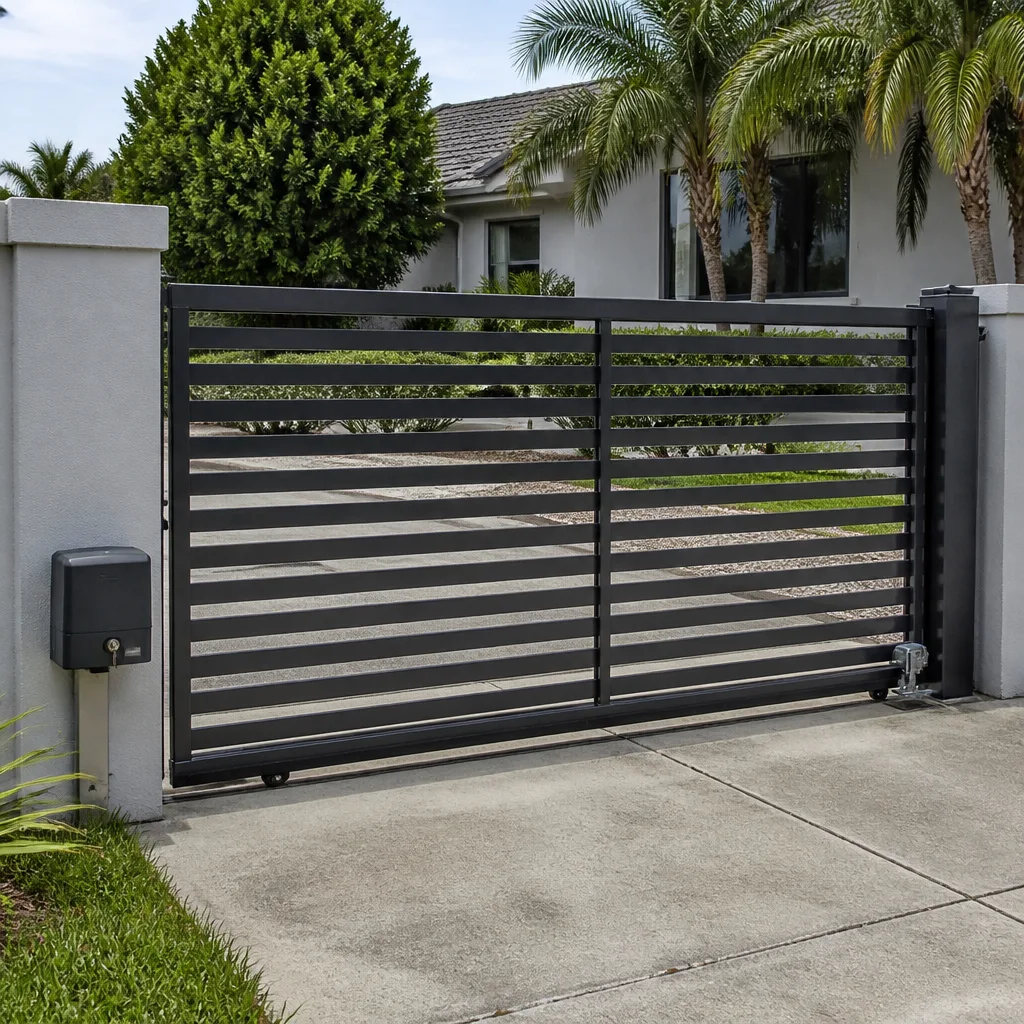 Sliding driveway gates
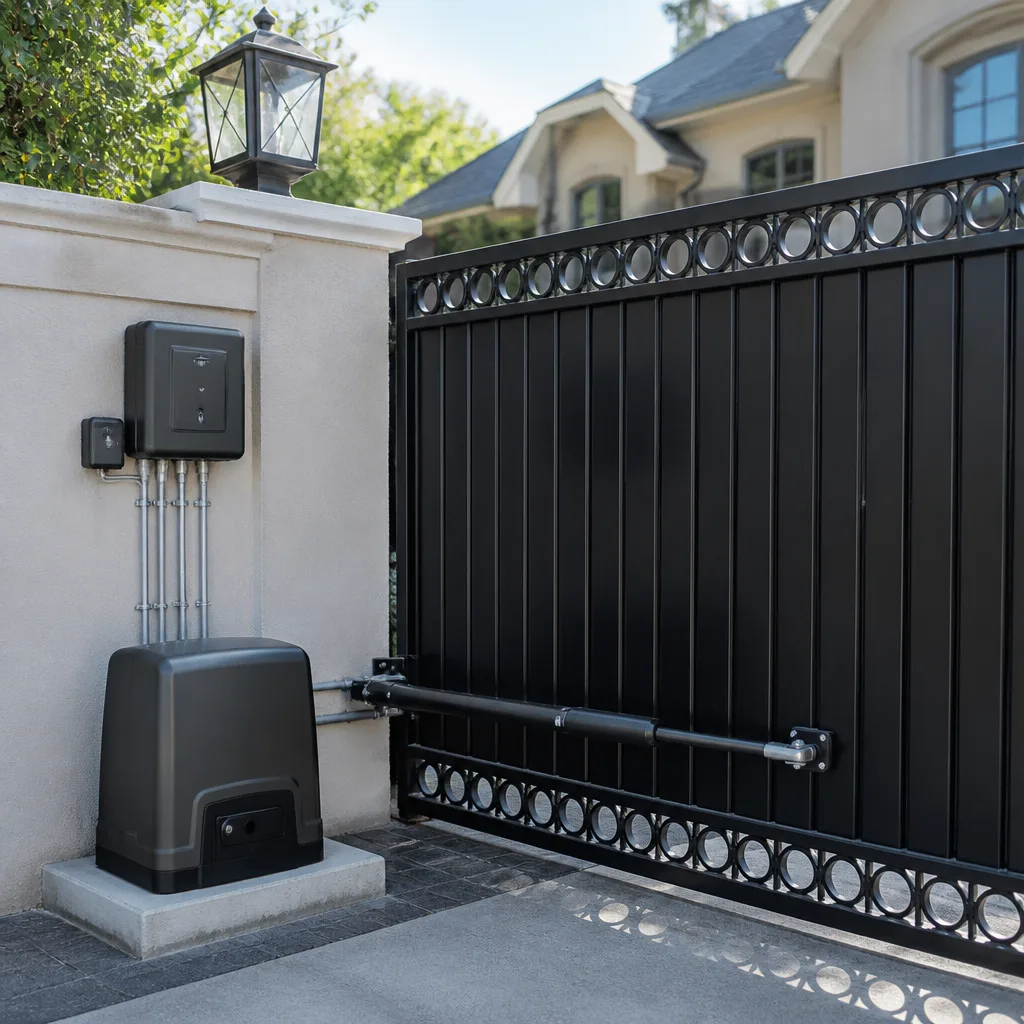 LiftMaster operators
Free on-site gate assessment - hinges, posts, and your LiftMaster or Nice gate operator checked before anything is quoted
The assessment is free and the quote is the invoice.
Get your free estimateGate Repair Warning Signs: A Fort Myers Homeowner’s Reference Guide
A gate that hesitates for two seconds before moving is not “just slow.” That pause is a motor drawing near-maximum amperage against resistance it can no longer overcome, and in our experience, that specific symptom typically means failure within 30 to 60 days. Fort Myers homeowners call us after the fact, standing beside a gate frozen half-open, when the truth is the gate spent weeks or months announcing the problem. This guide—along with our more guides & resources—teaches you to read those announcements before a nuisance becomes a security emergency at 11 p.m. in a Fort Myers summer thunderstorm.
Styles & brands we work with
Quick Answer
The most common gate repair warning signs in Fort Myers fall into five categories: unusual sounds (grinding, clicking, humming without movement), visible sag or rust at hinge points, erratic operator behavior (partial cycles, random reversals, shrinking remote range), slow or labored movement, and water or corrosion damage at the motor housing and control board. Any single sign warrants a call for our Gate Repair services. Two or more signs together almost always mean a component is close to failure. The earliest intervention is always the cheapest.
Table of Contents
- The Five Auditory Warning Signs and What Each One Means
- Visual Indicators: Reading Rust, Sag, and Hinge Geometry in Fort Myers
- Behavioral Red Flags in Automated Gate Systems
- Manual Failure vs. Operator Failure: Why the Distinction Matters
- The $200-to-$1,400 Timeline: Signs Homeowners Ignore for Months
- What Fort Myers Climate and Soil Do to Gate Hardware
- A Seasonal Gate Inspection Checklist for Fort Myers Homeowners
- Common Mistakes to Avoid
- When to Call a Professional
- Frequently Asked Questions
- The Bottom Line
The Five Auditory Warning Signs and What Each One Means
Gates talk. Most homeowners just don’t know the language. Every sound a gate makes is a diagnostic clue, and the five sounds below account for the overwhelming majority of service calls we run across Fort Myers neighborhoods from McGregor Boulevard to Gateway. Learn them, and you’ll know whether you’re dealing with a lubrication issue or a control board about to die.
1. Grinding or Metal-on-Metal Scraping
A grinding noise during gate travel almost always points to one of three things: a wheel or roller bearing that has seized, a hinge that has lost its bushing, or a drive gear that has worn past tolerance. On cantilever and sliding gates common to larger Fort Myers properties along the Caloosahatchee, the culprit is often a failed roller bearing inside the track truck assembly. The sound is the gate dragging its own weight across metal that no longer rotates. Left unaddressed, the friction load transfers to the operator motor, which then burns out trying to do double duty. This is the single most preventable motor failure we see.
2. Clicking Without Movement
A rapid clicking sound when you press the remote means the operator’s control board is receiving the signal and attempting to engage the motor, but the motor or capacitor cannot start. Think of it as a car with a dead starter: the solenoid clicks, but the engine never turns over. On a Ghost Controls or Mighty Mule residential swing operator, this is frequently a failed start capacitor, a component that costs a fraction of a full operator replacement. Because the click is soft, homeowners dismiss it for weeks, pressing the remote repeatedly until the gate eventually lurches into motion. Every one of those failed start attempts generates heat in the motor windings. The repeated strain converts a $150 part replacement into a full motor burn-out.
3. Humming With No Movement
An electric gate operator that hums but doesn’t move the gate is telling you the motor is getting power but the drive train is blocked or decoupled. On a swing gate, this is often a stripped drive gear, a snapped chain, or a broken coupling between the motor shaft and the arm. On a hydraulic operator like many FAAC and BFT models, a hum with no movement points to low hydraulic fluid, a failed pump, or a bypass valve stuck open. Here’s the critical point: a humming motor that isn’t moving is drawing locked-rotor current, which is several times its normal operating draw. That heat destroys motors quickly. If you hear a hum, cut power to the operator at the breaker and call for service. Don’t keep pressing the remote.
4. Intermittent Beeping
Many automated gate operators beep for a reason: a fault is being reported. The pattern matters. A single beep on some DoorKing boards indicates an obstruction detection event. A continuous or repeating beep often signals a failing battery backup, a misaligned safety sensor, or a limit switch that has drifted out of position. In Fort Myers, where afternoon lightning storms knock out power regularly, a beeping operator is frequently warning you that the backup battery has reached the end of its service life, typically three to five years in our climate. The beep is the gate’s way of saying the next outage will strand it in whatever position it was in when the power failed.
5. Unusual Silence
The most ignored warning sign is the one that makes no sound at all. A gate system that previously whirred, clicked, or beeped during operation and has suddenly gone completely silent, while still moving, often means a safety device has been bypassed or has failed silently. This is common with photoelectric sensors and edge sensors on older systems. The gate still opens and closes, so the homeowner assumes all is well. But a gate operating without functional safety sensors is a serious liability risk, especially for homes with children or pets. In Florida, many municipalities and HOAs require operational safety devices on automated gates. Silence is not golden here.
Visual Indicators: Reading Rust, Sag, and Hinge Geometry in Fort Myers
Auditory cues are only half the picture. Fort Myers sits in a salt-air corridor that accelerates corrosion on metal gate hardware at a rate that surprises people who moved here from inland states. Visual inspection catches the problem before you ever hear it.
Rust Bleed Patterns: Structural vs. Cosmetic
Not all rust is equal. Cosmetic corrosion produces a uniform, powdery orange film across exposed surfaces. It looks bad but rarely compromises strength in the short term. Structural rust is different: it appears as concentrated, dark, crusty streaks bleeding from joints, welds, and bolt holes. Those streaks mean water is entering a seam and oxidizing from the inside out, and that’s the corrosion that destroys gate frames. On Fort Myers gates, we see structural rust most often at the bottom rail of aluminum gates where salt-laden sand and irrigation overspray sit against the metal for years. Aluminum doesn’t rust the way steel does, but it does suffer from galvanic corrosion when it’s in contact with uncoated steel hardware, and the white, chalky buildup at joint points is the telltale sign. If you can flake material away with a screwdriver at any point on the gate frame, the frame has lost structural integrity, and welding or section replacement is in your near future.
Gate Sag Geometry: Hinge Failure vs. Post Movement
Stand back and sight down the top rail of your closed gate. A gate that sags at the latch side, with the top rail sloping downward, is experiencing one of two failures. If the gap between gate and post is tight at the top hinge and wide at the bottom hinge, the hinge itself has worn: bushings are ovaled, the pin has wallowed out its hole, or the hinge leaf has bent. This is a repair that usually costs a few hundred dollars for a new heavy-duty hinge and realignment. But if the gate post itself is leaning, the problem is below grade. In Fort Myers, where much of the soil is sandy and wet-season groundwater runs high, post movement is common, especially on posts set with too little concrete or no concrete collar at all. Sag from hinge wear is a gate problem. Sag from post movement is a foundation problem disguised as a gate problem, and it will recur until the post is reset properly.
Wheel and Track Wear on Sliding Gates
Sliding gates on Fort Myers waterfront properties ride on wheels that run inside a track or on a rail. Watch the gate as it moves. If it shudders or rocks side to side, a wheel is flat-spotted or a track bearing has failed. Run your hand along the top of the track, if accessible, and feel for notches or grooves worn into the rail. In sandy soil, grit acts as an abrasive paste that accelerates track wear dramatically. A notched track forces the gate to climb and drop with every cycle, which then destroys the next wheel in line. This is a cascading failure that starts with a $60 bearing and ends with track replacement.
Behavioral Red Flags in Automated Gate Systems
An electric gate that acts strangely is sending you data. The three behaviors below are not glitches, and they don’t resolve themselves. They’re the electronic equivalent of a check engine light.
1. Partial Cycles
A gate that opens halfway and stops, or closes partway and reverses, is failing to complete its programmed travel. Partial opening usually points to an obstruction detection event: the operator’s current sensor thinks it hit something. On a well-adjusted system, that means you genuinely hit something. On a gate that has been in service for years in Fort Myers, where wind gusts from summer storms create constant resistance, a sensitive current sensor begins false-triggering. The operator’s brain concludes “obstruction” when the reality is “worn gearbox increasing current draw.” The fix is often a limit switch adjustment or a replacement gear, not a new gate. Partial closing is more dangerous: it often means a safety edge or photo eye is intermittently tripping. That’s a sensor on its way out, and one day it will fail in the closed position, which means no safety protection at all.
2. Random Reversals
A gate that reverses direction mid-cycle for no apparent reason is a classic symptom of a failing capacitor, a control board overheating, or a limit switch drifting out of adjustment. On LiftMaster operators, we see this when the circuit board’s thermal protection kicks in mid-cycle because a failing capacitor is driving up operating temperature. The board resets, the gate reverses, and the homeowner assumes a child or animal triggered the sensor. The tell is consistency: random reversals that happen at roughly the same point in travel, every time, are motion control failures, not obstacle events.
3. Remote Range Degradation
The day your remote worked from the end of the street, and now it only works from the driveway, is not the day you need a new remote. Shrinking range is a diagnostic clue. It means the receiver’s antenna signal-to-noise ratio is being degraded, often by a failing power supply injecting electrical noise into the control board, or by a receiver that is slowly losing sensitivity as a capacitor ages. In Fort Myers, high humidity also corrodes antenna connections inside the operator housing, and that corrosion acts as a resistor that eats range a few feet at a time. Replacing the remote rarely solves it. Replacing or repairing the receiver does. On a DoorKing or Elite system, an antenna connection clean-and-reseat or a receiver board replacement typically restores full range.
Manual Failure vs. Operator Failure: Why the Distinction Matters
Here’s a diagnostic question that separates gate specialists from guessers: does the gate work normally when you disengage the operator and push it by hand? The answer splits all gate failures into two completely different problems, and solving the wrong one wastes time and money.
If the gate moves freely and smoothly by hand, the mechanical system (hinges, wheels, track, frame) is sound. The problem lives in the operator: the motor, the capacitor, the control board, the limit switches, or the power supply. This is an electric gate repair job, and in most cases, the fix is a component replacement rather than a full operator swap. A brand-agnostic specialist who works on LiftMaster, FAAC, BFT, Linear, Viking, Ghost Controls, DoorKing, Elite, and Mighty Mule can identify and replace the failed board or motor without requiring you to abandon your existing system.
If the gate is stiff, heavy, or binding when you push it by hand, the operator is fighting a mechanical problem, and that mechanical problem is what’s killing the operator. Putting a new motor on a gate with seized hinges is like replacing the engine in a car with flat tires. The primary repair lives on the gate repair side, and once the mechanical resistance is removed, the existing operator often returns to normal operation. In our experience across Fort Myers, a significant share of “failed operators” are actually healthy operators that burned themselves out pushing against a gate that no longer moved freely.
The takeaway: test the gate by hand. It takes 30 seconds and tells you which company to call, which parts are likely involved, and whether you’re looking at a hinge replacement or a control board.
The $200-to-$1,400 Timeline: Signs Homeowners Ignore for Months
The same repair has two prices. The first price is what it costs when you act at the first warning sign. The second price is what it costs after the ignored warning sign destroys the components around it. Here is what that timeline looks like for the three most common failures we see in Fort Myers.
Scenario 1: A Worn Hinge Becomes a Bent Frame
- Month 1: You notice the gate squeaks and the latch side sits a quarter-inch low. The cause is a worn hinge bushing. Repair cost: roughly $150 to $250 to replace the hinge and realign the gate.
- Months 3 – 6: The sag worsens because the gate is now levering against the remaining hinge. The frame begins twisting. The latch stops engaging cleanly and you have to lift the gate to close it. Repair cost: hinge replacement plus frame reinforcement, roughly $500 to $800.
- Months 8 – 12: The twisting frame has now transferred stress to the operator arm, which has bent or stripped. The operator motor has been running against increasing resistance for months and its windings are compromised. Full replacement gate and operator: roughly $1,200 to $1,400 or more, depending on gate size and operator model.
Scenario 2: A Failing Capacitor Becomes a Dead Motor
- Week 1: The gate starts slowly and needs a second remote press some days. The start capacitor is aging. Repair cost: roughly $80 to $150 for a new capacitor and 30 minutes of labor.
- Month 2: The gate now clicks repeatedly before moving. Each failed start heats the motor windings. The capacitor is essentially dead and the motor is absorbing the damage. Repair cost: capacitor replacement plus motor inspection, roughly $200 to $350.
- Month 3: The motor finally refuses to start at all. The windings are scorched. A capacitor and a motor are now both required, and on a high-cycle gate, the control board may have been stressed as well. Total: $700 to $1,100, plus the gate has been unreliable for a quarter of a year.
Scenario 3: Track Debris Becomes Track Replacement
- Month 1: The sliding gate shudders slightly when it passes the midpoint. A wheel bearing is wearing or grit is accumulating in the track. A service call to clean, inspect, and replace one bearing runs $150 to $275.
- Months 3 – 4: The worn bearing has flat-spotted. Every opening cycle now grinds the flat spot against the track, cutting a groove. The gate shudders visibly. The track is being damaged. Repair cost now includes track dressing or a section repair, roughly $450 to $700.
- Months 6 – 8: The groove in the track is deep enough to catch the next wheel, which fails, then the next. The gate derails and the operator strains against a jammed track. Full track replacement, multiple wheels, possible operator damage: $1,000 to $1,400.
The pattern is identical in every scenario: the first repair is a component. The final repair is a system. Early intervention is the difference between a service call and a capital expense.
What Fort Myers Climate and Soil Do to Gate Hardware
Fort Myers is not a neutral environment for gate hardware. The combination of salt air from the Gulf, high year-round humidity, intense summer UV, and sandy, shifting soil creates failure patterns that gate owners further inland never experience. Here’s what the environment is doing to your gate, even when it’s sitting still.
Salt air is the quiet destroyer. Fine salt particles settle on metal surfaces and inside operator housings, where they combine with moisture to form a conductive, corrosive brine. This accelerates rust on steel components, but it does something worse to electronics: salt bridging across circuit board traces creates stray current paths that cause erratic behavior, false sensor triggers, and premature board failure. On unprotected control boards in Fort Myers, we see corrosion-related failures years earlier than identical boards in drier climates. The fix is preventive: sealing board housings properly, checking gaskets, and keeping drain holes clear.
High humidity attacks electrical connections. Terminal blocks and wire nuts inside operator housings corrode subtly, increasing resistance across connections. That resistance generates heat, and that heat degrades insulation and terminals over time. A connection that looks fine from the outside may be a high-resistance failure point. This is why a Fort Myers gate that has “always worked fine” can fail abruptly after a decade: the corrosion crossed a threshold the same week the equipment crossed it.
Sandy soil is the mechanical enemy. Fort Myers sits on sandy loam, and gates on posts set in that soil are subject to more movement than gates set in clay or rock. The sand drains quickly, which sounds good, but it also allows posts to shift under repeated load cycles, especially if the post was set with inadequate concrete or no concrete collar. A shifting post translates directly into hinge binding and operator strain. On sliding gates, sand blows and washes into tracks constantly, creating the abrasive paste mentioned earlier. Owners of sliding gates in Fort Myers should inspect and clean their tracks after every major rain event.
A Seasonal Gate Inspection Checklist for Fort Myers Homeowners
Every homeowner in Fort Myers should run through this checklist—detailed in our Seasonal Gate Repair Care for Fort Myers: Year-Round Homeowner’s Guide—twice a year, ideally in April before the summer storm season and again in October after it ends. Each item takes less than a minute. Together they catch most failures before they strand you.
- Listen to one full open-and-close cycle. Stand at the gate and operate it. Note any grinding, clicking, humming, or hesitation. Silence that used to be mechanical whirring is also a note.
- Sight the top rail. With the gate closed, step back 20 feet and look at the top edge. Is it level? A gate that slopes toward the latch side is sagging.
- Check the hinge area. Look for rust streaks, cracked welds, missing bolts, or a gap that changes width between the top and bottom of the hinge when the gate moves.
- Push the gate manually. Disengage the operator (use the manual release, usually a red handle or key) and push the gate by hand. It should move smoothly with moderate effort. Binding, heaviness, or grinding is a mechanical problem.
- Inspect the photo eyes and safety edges. Wipe the lenses on both photo sensors. Check that the wiring to any rubber safety edge is intact and not cracked or pulled. Test obstruction reversal by placing a trash can (not a person) in the gate path and confirming the gate reverses.
- Examine the track or rail on sliding gates. Clear out leaves, sand, and debris. Look for notches, grooves, or accumulated grit packed into bearing areas.
- Check the operator housing. Open the cover if you’re comfortable doing so and look for insect nests, water stains, corrosion on terminals, or a swollen or leaking backup battery. If you are not comfortable, this is a 15-minute item for a service call.
- Run the gate on battery backup. If your system has one, cut power at the breaker and operate the gate. It should run at reduced speed for at least a few cycles. If it doesn’t, the battery has failed.
Eight items. Ten minutes. Twice a year. This routine catches most $1,400 failures while they’re still $200 repairs.
Common Mistakes to Avoid
- Lubricating everything with WD-40. WD-40 is a water displacer, not a lubricant, and it degrades plastic bushings and attracts grit. Use a dry-film lubricant or a lithium grease appropriate for gate hardware, and keep lubricants away from the operator internals. If you’re unsure what to use, ask a specialist.
- Adjusting the limits yourself. On most operators, limit switches are not homeowner-adjustable, and turning screws without knowing the system defeats the safety logic. An obstruction that now “presses through” because you adjusted the current sensing is a gate waiting to injure someone.
- Replacing the remote when range shrinks. As covered above, declining range is usually a receiver, antenna, or power supply issue. A new remote masks the symptom for a few weeks and wastes $40 to $80.
- Ignoring the beeps. Fault codes exist for a reason. Ignoring a beeping operator because the gate still works is like ignoring a smoke alarm because you can’t see the fire. In Fort Myers’s frequent power outages, a beeping battery backup warning is a standing invitation to a stranded gate.
- Pushing the gate through resistance. If the gate hesitates, slows, or stops and you resolve it by pressing the remote again or pushing the gate manually, you are generating heat and damage in the motor. Every assisted cycle shortens the motor’s life.
- Treating rust as a paint problem. Painting over structural rust makes the gate look better while the corrosion continues underneath. If the rust is bleeding from a seam or joint, the fix is a repair or replacement, not a coat of paint.
- Writing off repairs in favor of replacement. We regularly see homeowners quoted for a full gate replacement when the actual fix is a hinge, a capacitor, or a limit switch. Before you sign a replacement estimate, get a diagnostic exam from a specialist who repairs what others replace. A $1,400 replacement is sometimes the right answer. It is not always the only answer, and a brand-agnostic diagnosis protects you from a sales-driven one.
When to Call a Professional
Some gate issues are fixed with a wrench and thirty minutes. Some are electrical, some are structural, and some create genuine safety hazards for you and your family. The line between them is not always obvious, which is why the safest response to any warning sign in this guide is a diagnostic call. Call a professional immediately if you hear a motor humming without movement (locked-rotor current can start a fire), if the gate reverses randomly or fails to hold position, if the sag is visible enough to affect latching, or if a safety sensor or edge has failed. A gate that crushes a child or a pet is not a theoretical risk, and Florida code requires functioning safety devices on automated gates. Courtyard Gate Repair offers free estimates in Fort Myers, and we’d rather spend an hour diagnosing a problem that turns out to be minor than have you gambling with a gate that’s already told you it’s failing. Call (844) 791-3898 and we’ll give you a straight answer, not a sales pitch.
Frequently Asked Questions
A gate that clicks but doesn’t move is usually a failed start capacitor or a motor that cannot start against resistance, and in Fort Myers, corrosion on the control board connections can also contribute to start failures. The click is the control board attempting to engage the motor. Repeated attempts while the gate doesn’t move will burn out the motor, so stop trying and call for diagnosis. At Courtyard Gate Repair, we identify whether the capacitor, the motor, or the board is the actual failure before anyone reaches for a replacement. Call (844) 791-3898 for an exact diagnosis, estimates are free.
Gate repair in Fort Myers typically ranges from $150 to $500 for common component failures like hinge replacements, capacitor swaps, limit switch adjustments, and track cleanings. More involved repairs, like control board replacements or motor rewinds, run $400 to $900, and full gate or operator replacements rarely land under $1,200. The single biggest variable is how early the problem was caught, and we quote every price before any work starts, so you’ll never get a surprise invoice. Call (844) 791-3898 for a precise quote after a diagnostic visit.
Yes, Courtyard Gate Repair responds to emergency gate failures in Fort Myers, especially for gates stuck open, which create both security and liability exposure. Call (844) 791-3898 and we’ll give you a straight answer on arrival timing. For non-emergency repairs, we’ll schedule at your convenience.
Yes, that pattern indicates the mechanical gate itself is sound and the problem is inside the operator, the receiver, or the power supply. This is a completely different repair path than a gate that binds manually, and it typically involves a component-level fix like a receiver board, a capacitor, or a limit switch rather than a full replacement. We repair what others replace, and we start with diagnosis, not a replacement quote. Call (844) 791-3898 and we’ll identify the actual failed part before anything else happens.
Random reversals at roughly the same point in travel are usually a limit switch drifting out of position, an overheating control board, or a sensor that is intermittently tripping due to wind, corrosion, or aging. The gate’s control board interprets these false signals as obstructions and reverses. Left unattended, the false tripping often becomes permanent, and your gate may ultimately refuse to close at all. A diagnostic visit from a specialist isolates the actual source in about an hour.
A full gate installation typically includes the gate frame and infill panels, heavy-duty hinges or a track system, the operator and control board, all safety devices including photoelectric sensors and safety edges, power supply wiring, and programming for remotes and keypads. In Fort Myers, we also account for the local environment by setting posts below grade properly in concrete, sealing control board housings against humidity, and sizing operators for the wind and salt-air conditions they’ll face. Every installation is quoted as a complete written price before work begins, and we never leave out safety edges or photo eyes to make a quote look cheaper. Call (844) 791-3898 for free measure and a written price.
We service all of those brands and more. Whether you’ve got a Ghost Controls residential swing opener, a DoorKing commercial slide operator, or a Mighty Mule on a driveway gate, our technicians diagnose the system as a system, not by brand loyalty. The right fix for your gate is the fix that works, whether that’s a DoorKing board, a Mighty Mule arm, or a hint that your gate system needs something entirely different. Your brand. Our expertise.
The Bottom Line
Gates don’t fail suddenly. They fail gradually, and they announce every stage of the failure in sounds, sag, and behavior that most homeowners in Fort Myers simply haven’t been trained to read. The grinding hinge, the clicking capacitor, the shrinking remote range, the beeping battery, the sag you can see from the street: these are not mysteries, and they’re not things you learn to live with. They are early warnings with a clear timeline and a much cheaper repair at the front end of it. Learn the five sounds, run the seasonal checklist, test the gate by hand, and call a specialist the moment a warning sign appears, and you’ll never be the person standing beside a frozen gate at 11 p.m. in a summer storm. That’s the entire point of this guide, and it’s the reason we wrote it down.
Courtyard Gate Repair offers free estimates in Fort Myers. Call (844) 791-3898 and you’ll get a straight diagnosis, an honest price, and a gate that goes back to working, well, and staying that way.
Written by the team at Courtyard Gate Repair, serving Fort Myers since 2017.
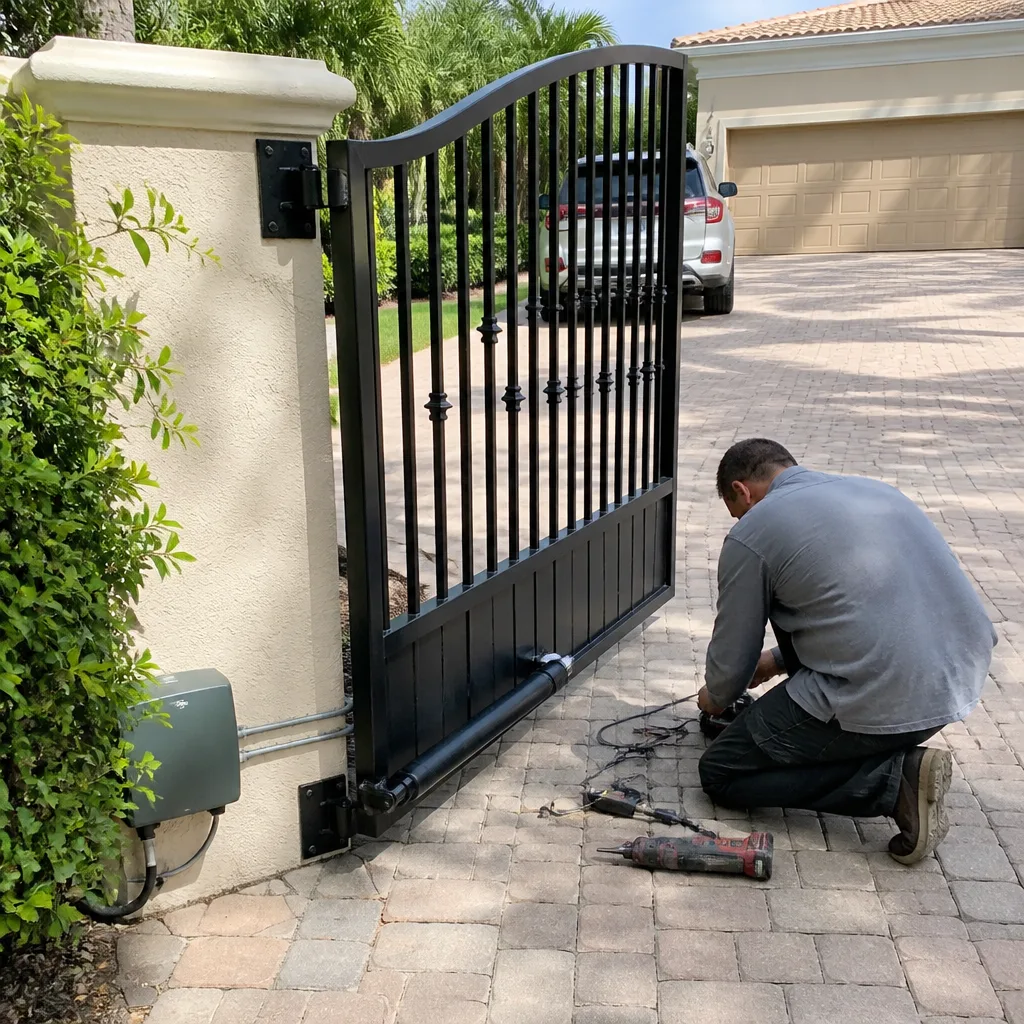
See the difference
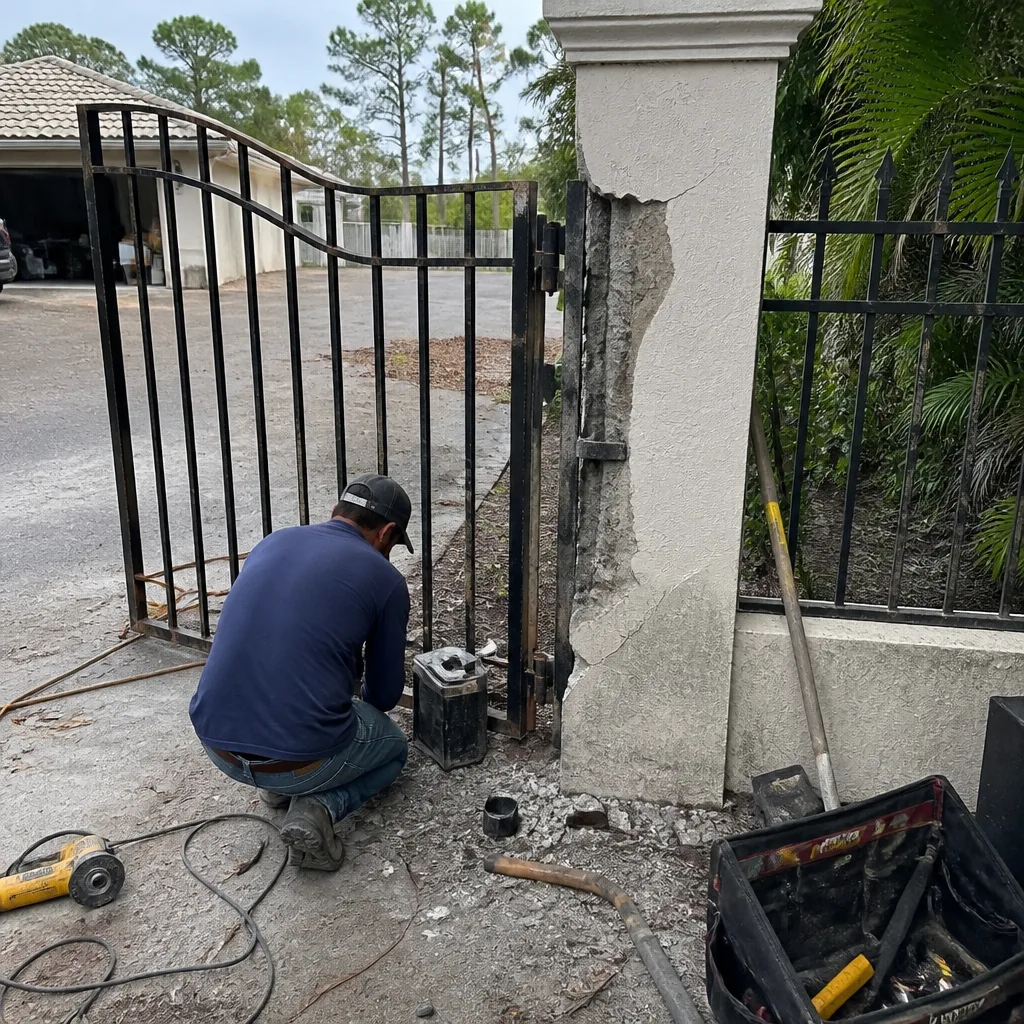 Before
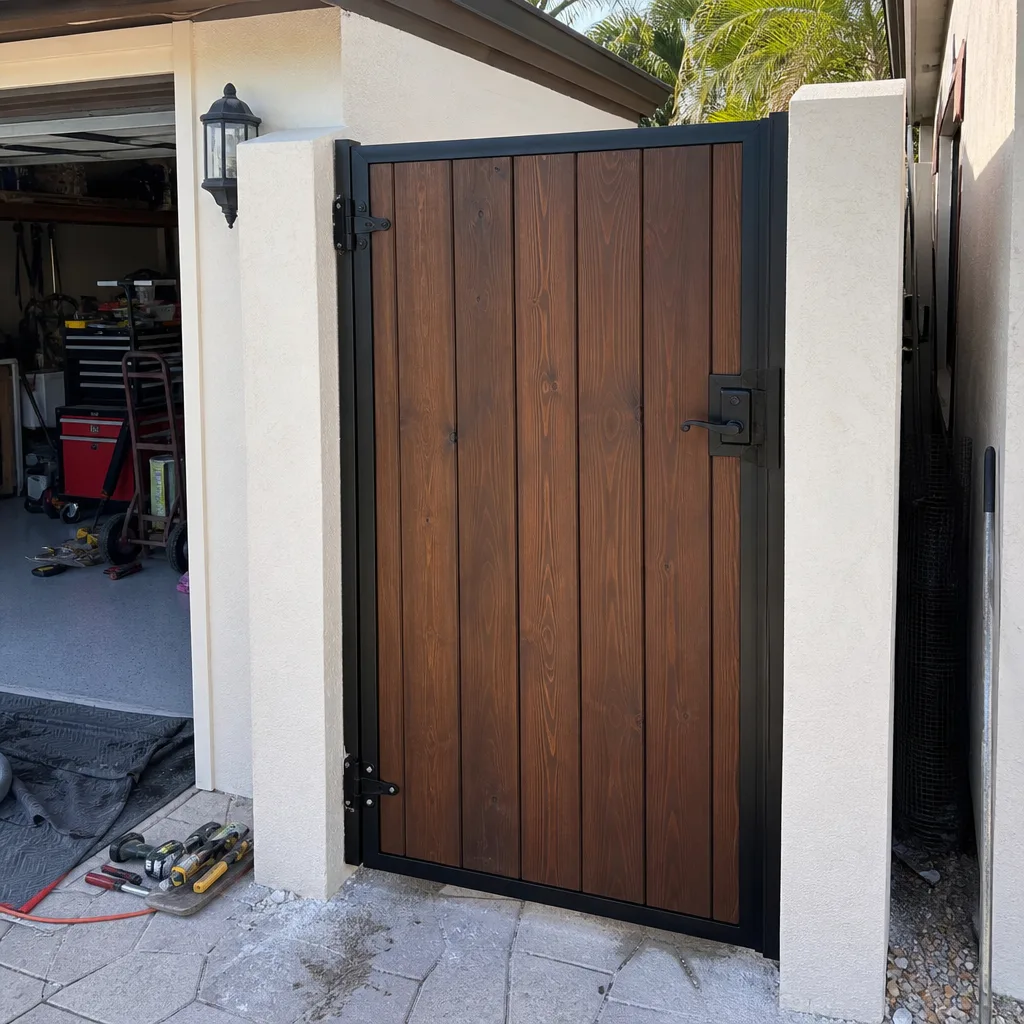 After
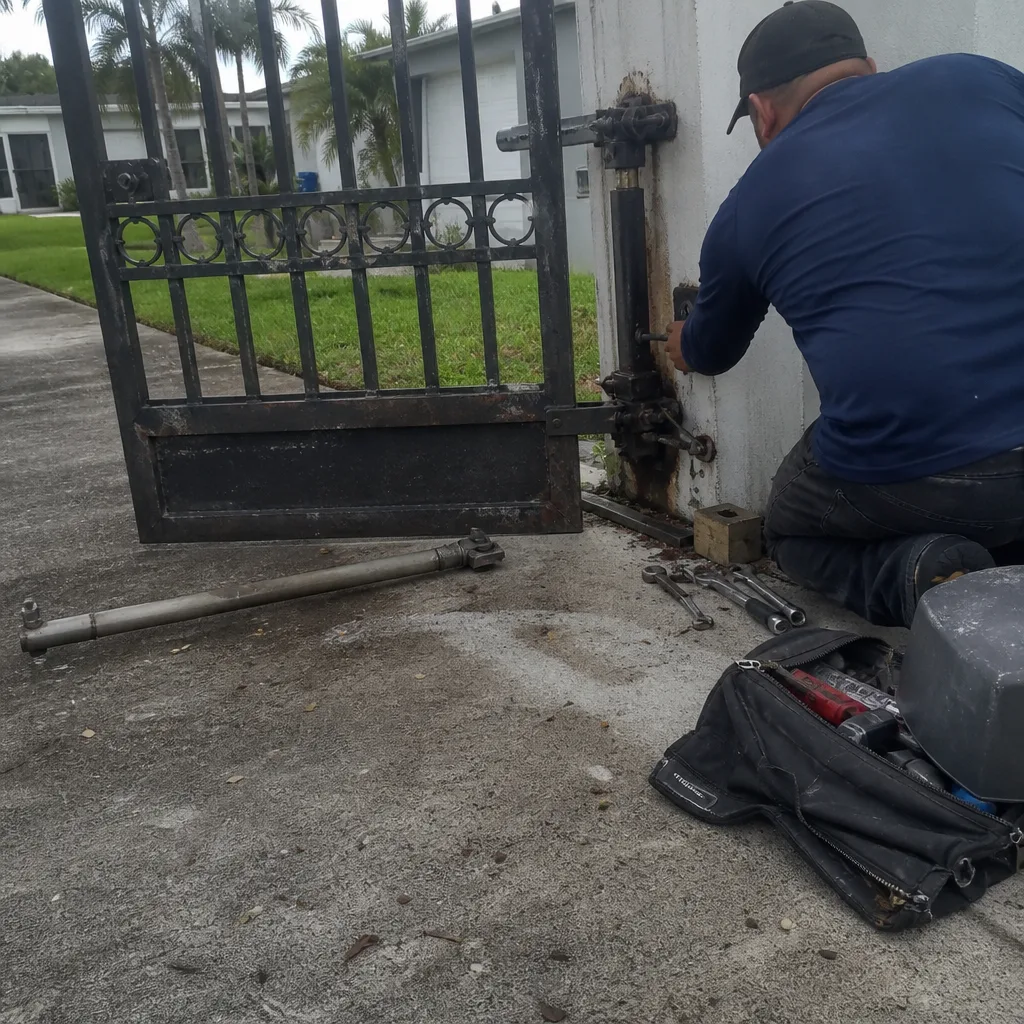
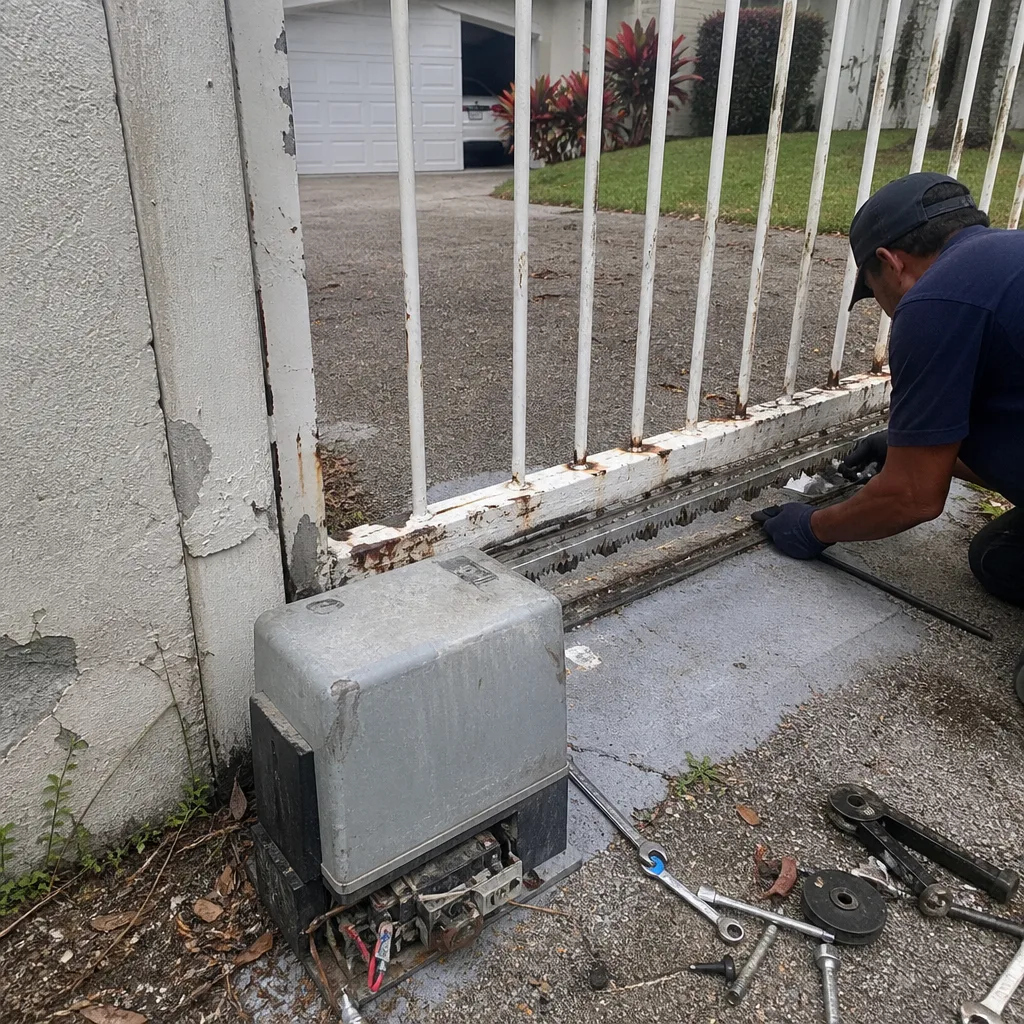 Before
 After
 Before
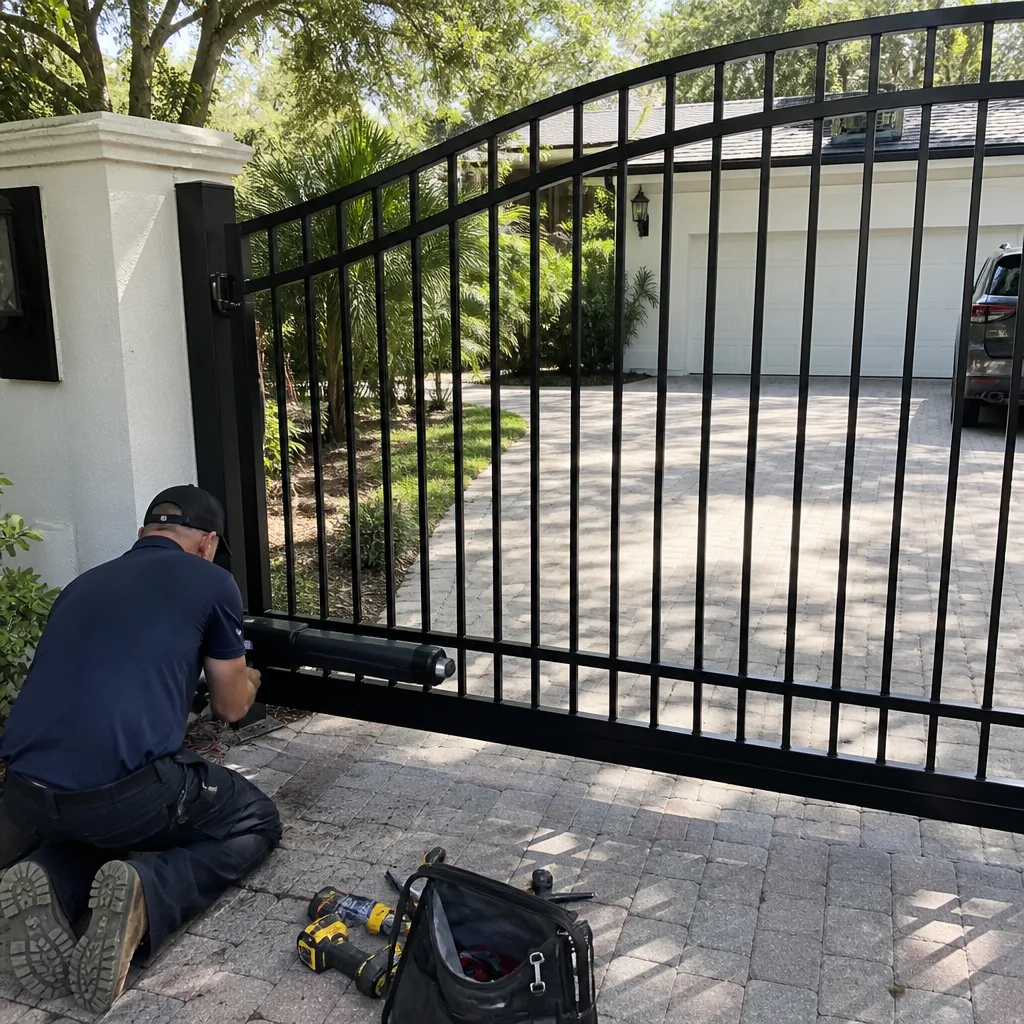 After